S1 · Seventy thousand on hold
The whole stadium, waiting
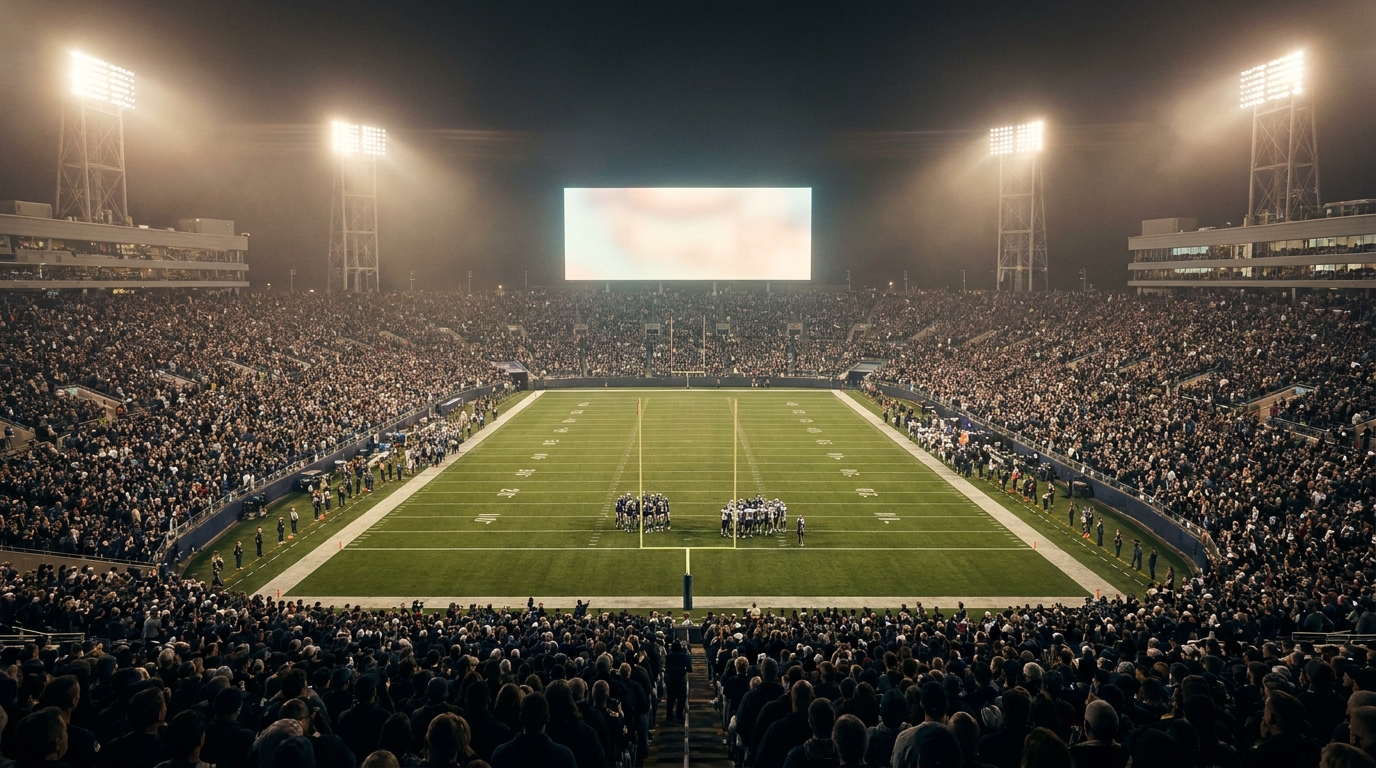
The wide plate everything else was built on: no logos, no numbers, no readable text anywhere, and in the film the big screen carries just two words.
Big screen: “PLEASE HOLD”
flaminGO Mobile is a proof-of-concept carrier brand, created to demonstrate a complete campaign. This page is its home: three spec commercials, the brand, and the system that made them. The newest is “Flag on the Play,” a big-game spot: a packed stadium, seventy thousand people on hold, and one tiny referee who has seen enough. Before that, “Hold, Please” kept Frankie on hold with the big guys until a person finally answered, and the first spot, “Big-Carrier Bill,” introduced him. All three films play right here. Directed end to end by me, made with AI.
23.5 seconds · 1920 × 1080 · 24 fps · Mix at -16 LUFS
A packed stadium at night, and everybody in it is on hold. Seventy thousand fans with phones to their ears, the players standing still at midfield, and the big screen stuck on PLEASE HOLD. It is the same problem as the kitchen spots, played at big-game scale: floodlights, a full broadcast graphics package, and a crowd that has been waiting three hours, twelve minutes and forty-seven seconds.
Then a whistle. Frankie, in a referee shirt, half the length of the football beside him, throws the flag: “Flag on the play! Holding!” His call to flaminGO is answered on the first ring, and the whole stadium goes up in pink.
The spot was built to show the campaign can carry a national, Super Bowl-style production: a photoreal stadium, an epic score, and Frankie holding his own in the middle of it, still tiny, still the same bird. Pink stays reserved for flaminGO through the whole film; everything from the big guys is slate.
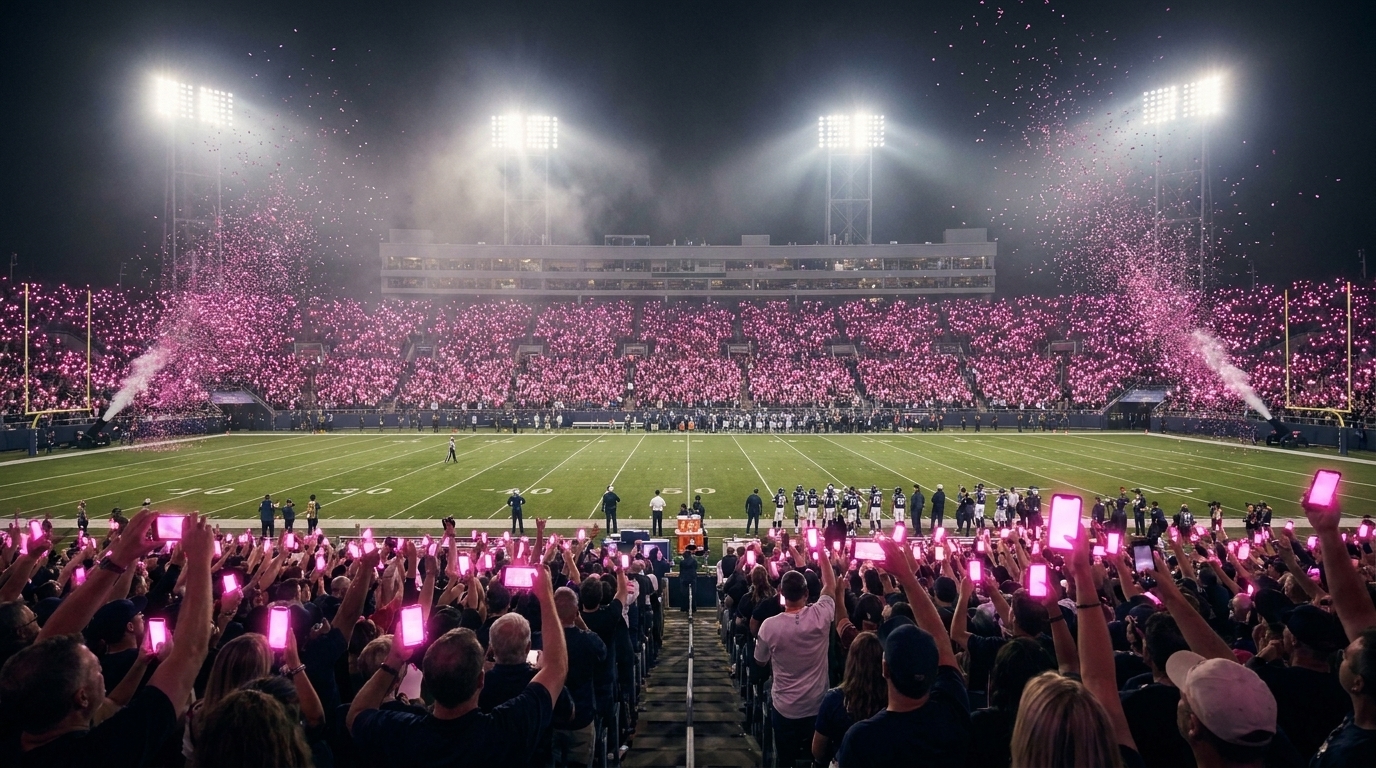
The wide plate everything else was built on: no logos, no numbers, no readable text anywhere, and in the film the big screen carries just two words.
Big screen: “PLEASE HOLD”
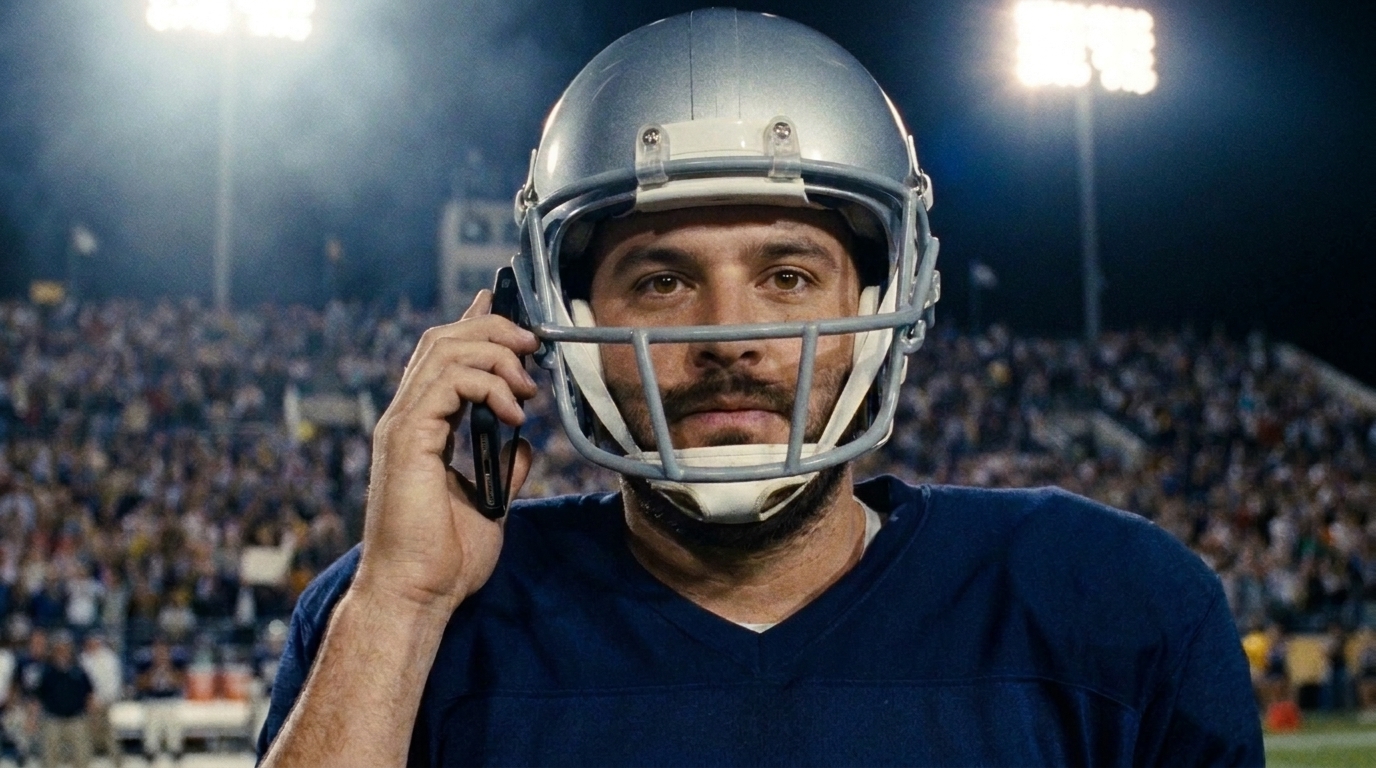
Phone pressed to the ear hole of his helmet, football under the other arm, playing to a crowd that is doing exactly the same thing.
Quarterback: “Still… on hold.”
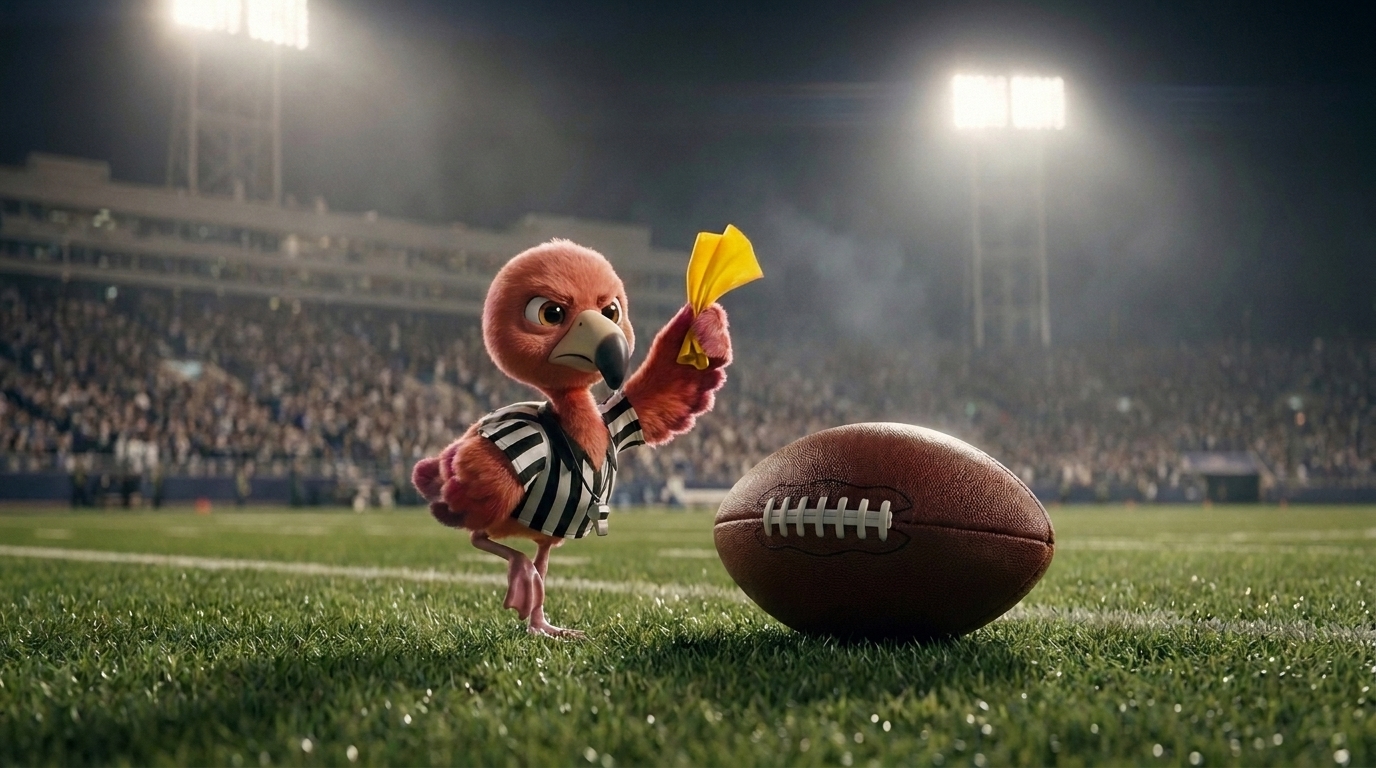
Frankie is kept at his locked size, about half the length of the football, by a scale frame attached to every shot he is in. The whistle blows, the flag flies, and the penalty card slams in over the top: HOLDING.
Frankie: “Flag on the play! Holding!”
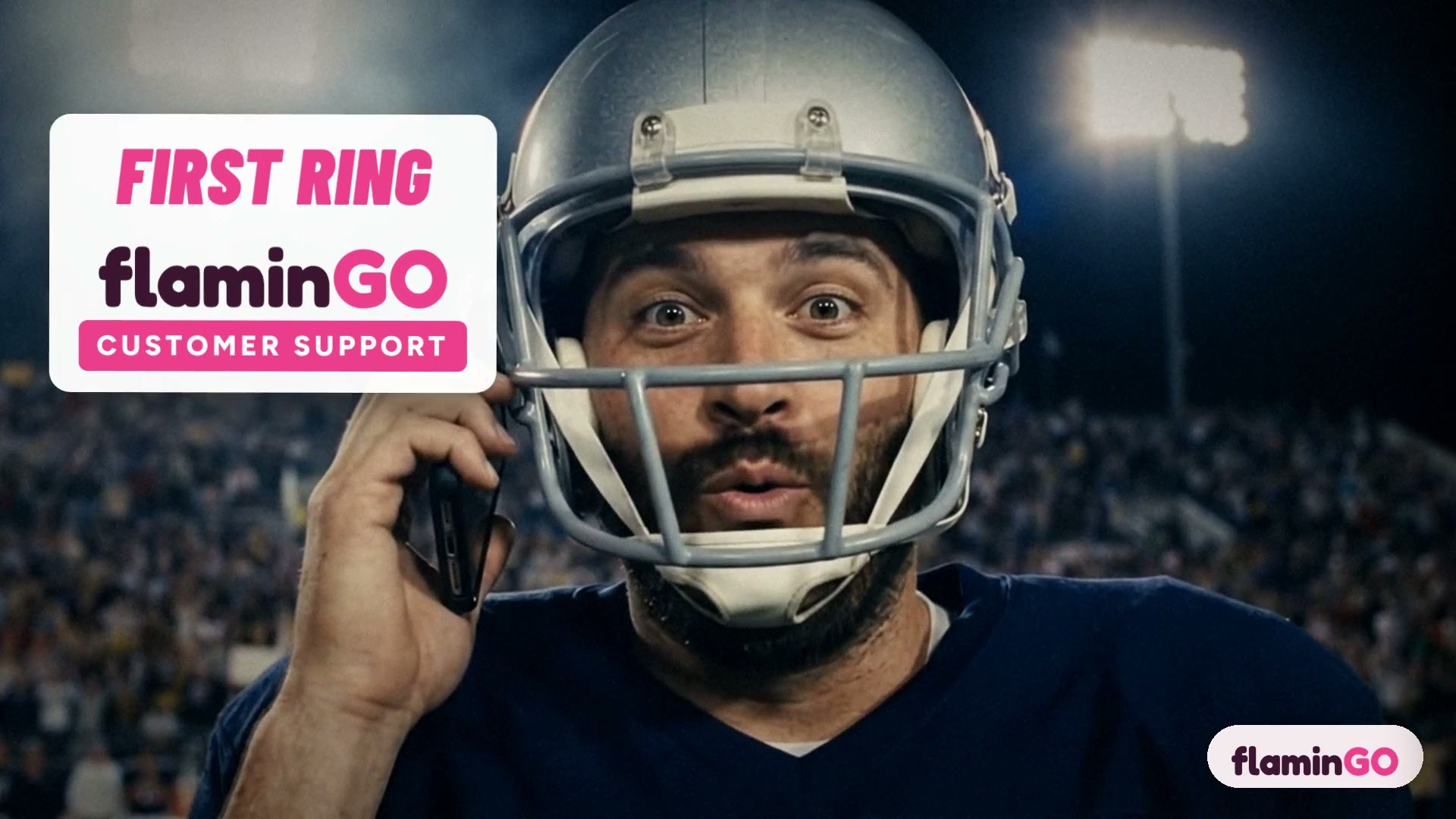
The same shot as S2, and that is the joke: the phone is still pressed to his helmet, but this time the FIRST RING support card lands beside his face and a person has answered. An earlier version of this beat, built around his phone screen glowing pink, was not used.
Quarterback: “Whoa! Flamingo picked up!”
The crowd booed the flag, then the phones went pink and the confetti cannons fired. The kinetic super says what the announcer says, in two lines.
Announcer: “Flamingo picks up. First ring.”
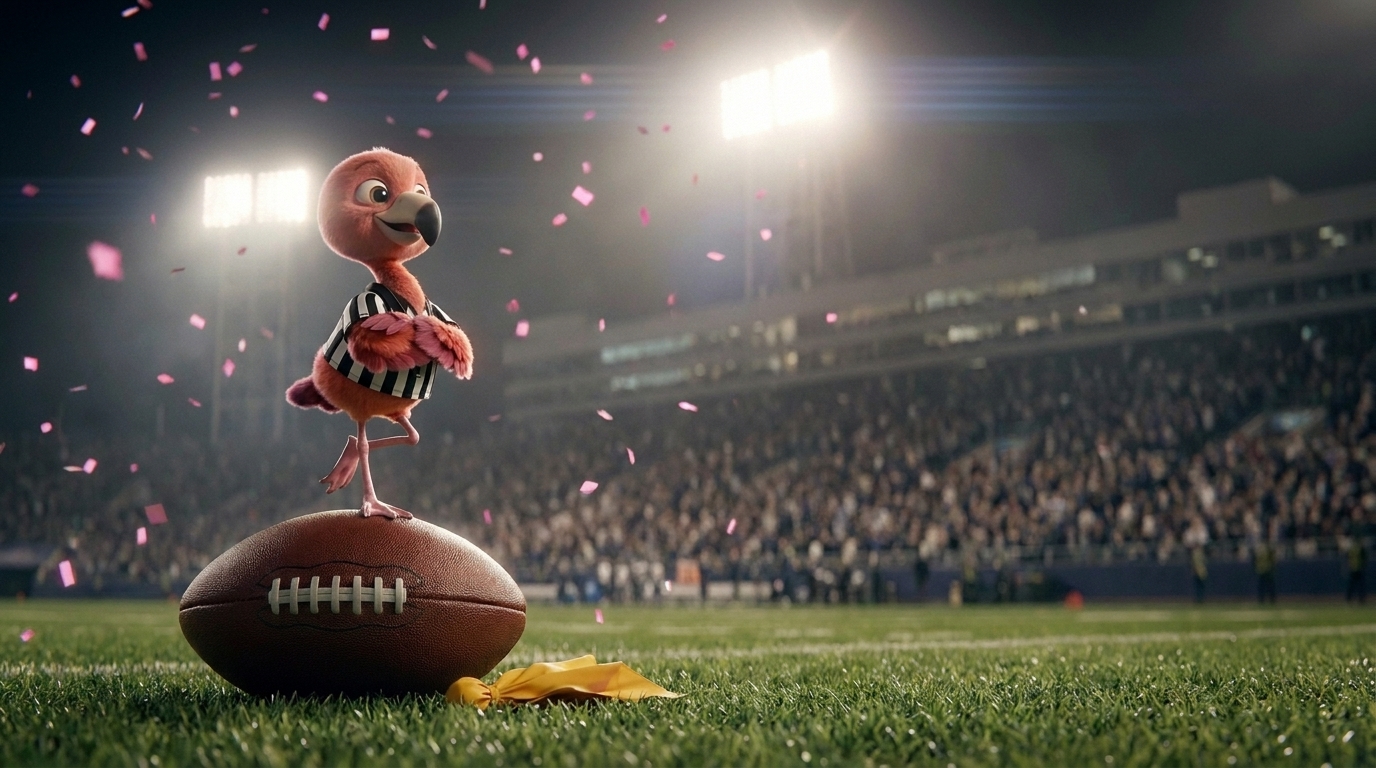
Frankie takes his place on top of the ball while the end card builds beside him on the right: the logo, then the two words the whole spot was making room for.
Announcer: “FlaminGO Mobile support.” Jingle: “Let’s go, flaminGO!”
Every spot starts as a written build plan: references, start frames, motion prompts, model settings and render lengths, worked out shot by shot. I make the film by working down that plan by hand. For Flag on the Play I wanted to know whether the plan itself could become the workflow.
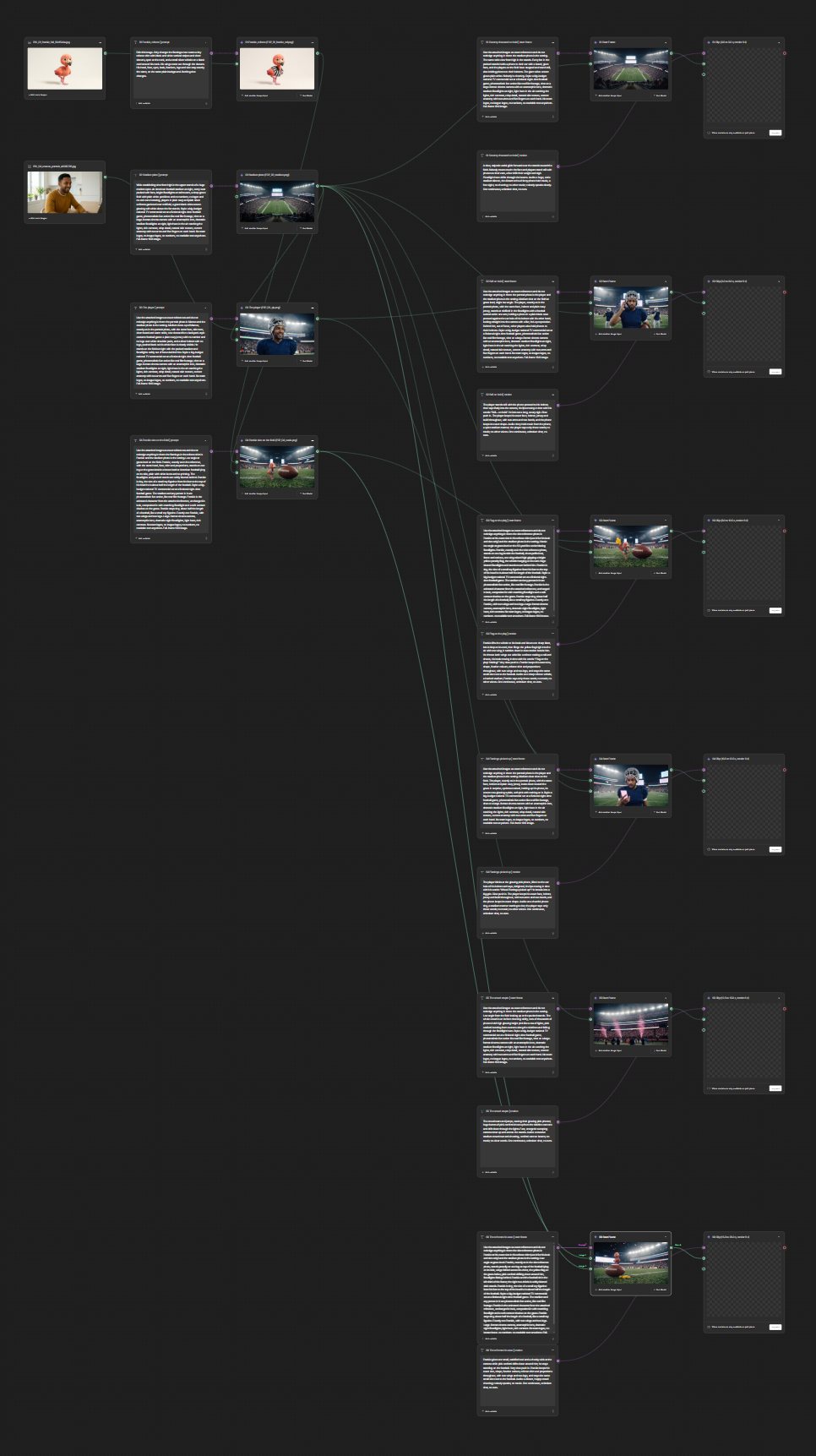
Figma Weave, a node-based canvas for AI image and video, has no way to build a board from a written plan. When you copy nodes in Weave, though, they land on the clipboard as structured text, and pasting that text back rebuilds them. Working with Claude, I worked out that format from a handful of copied samples. Now Claude writes the board itself, straight from the plan.
The result is the whole of Flag on the Play on one board: 34 nodes and 37 connections, with every prompt and setting already in place. Two photos go in. Four references are built from them: the referee, the stadium, the player, and Frankie at his true size. Six start frames are built from those references, one per shot, each wired to the video step that animates it.
I pasted the board, added the two photos and pressed run. The references and all six start frames came out of the board, each one matching its shot. Because every step is its own node, a shot that looks wrong is one node to rerun, and if Frankie changes, only what follows from him runs again.
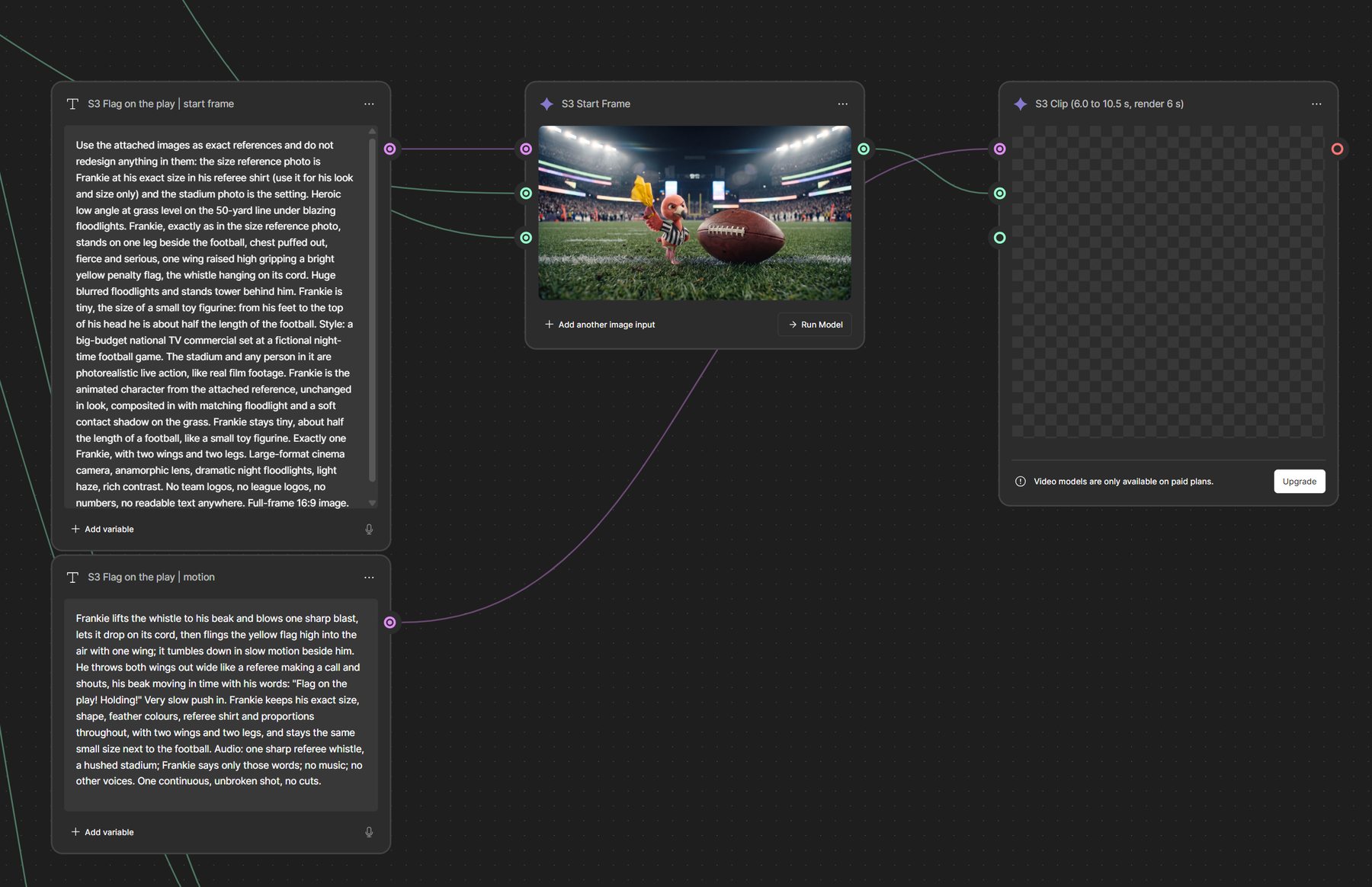
The finished film was made in Google Flow, before the board existed. On the board, the video steps are wired and set but have not been run yet, because Weave’s video models need a paid plan. Voice, music, graphics and the edit stay outside the board, as before. The full plan is in the Flag on the Play production guide.
The Production Guide
Why the first version of this spot, a complete commercial built in Runway, was rebuilt for Frankie in Google Flow, the one master frame every other frame was edited from, the voice replacement that kept Maya’s Runway lip sync, and the hold timer that had to be pinned to a locked-off camera. Opens in a new tab.
45.7 seconds · 1920 × 1080 · 24 fps · Mix at -16 LUFS
Frankie has been on hold with “the big guys” so long the timer has stopped being polite about it: 47 minutes, then three hours, a cobweb growing from his foot to the coffee mug. The robot keeps telling him his call is important to them. He has started to doubt it.
So he hangs up and calls flaminGO. One ring, and Maya answers: a real person. “One plan, one price, done.” There is only one problem. After three hours of it, Frankie has grown attached to the hold music, and he would like to be put back on hold, please. By request.
The film was built the way the first spot was built: one master frame of Frankie, approved first, and every other Frankie frame a single-change edit of it, animated in Google Flow with the camera locked off so the hold timer and the phone graphics could be pinned in the edit. Maya’s picture and lip sync were kept from the first version of the spot, the complete version built in Runway; her voice was replaced, at its original timing, the same way Frankie’s was in the first film. The final cut is a hybrid: a Runway performance and a Flow character, finished as one piece.
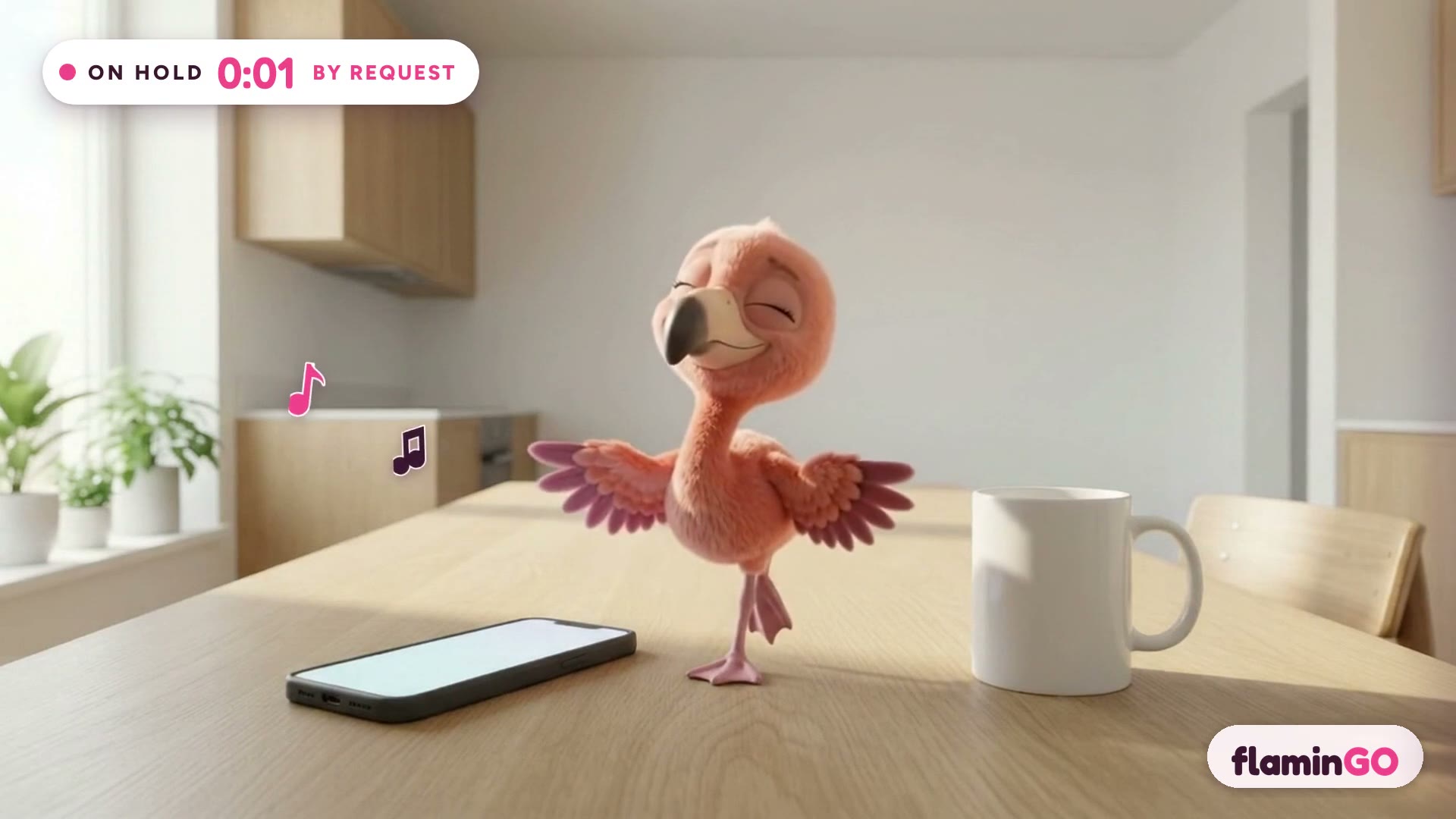
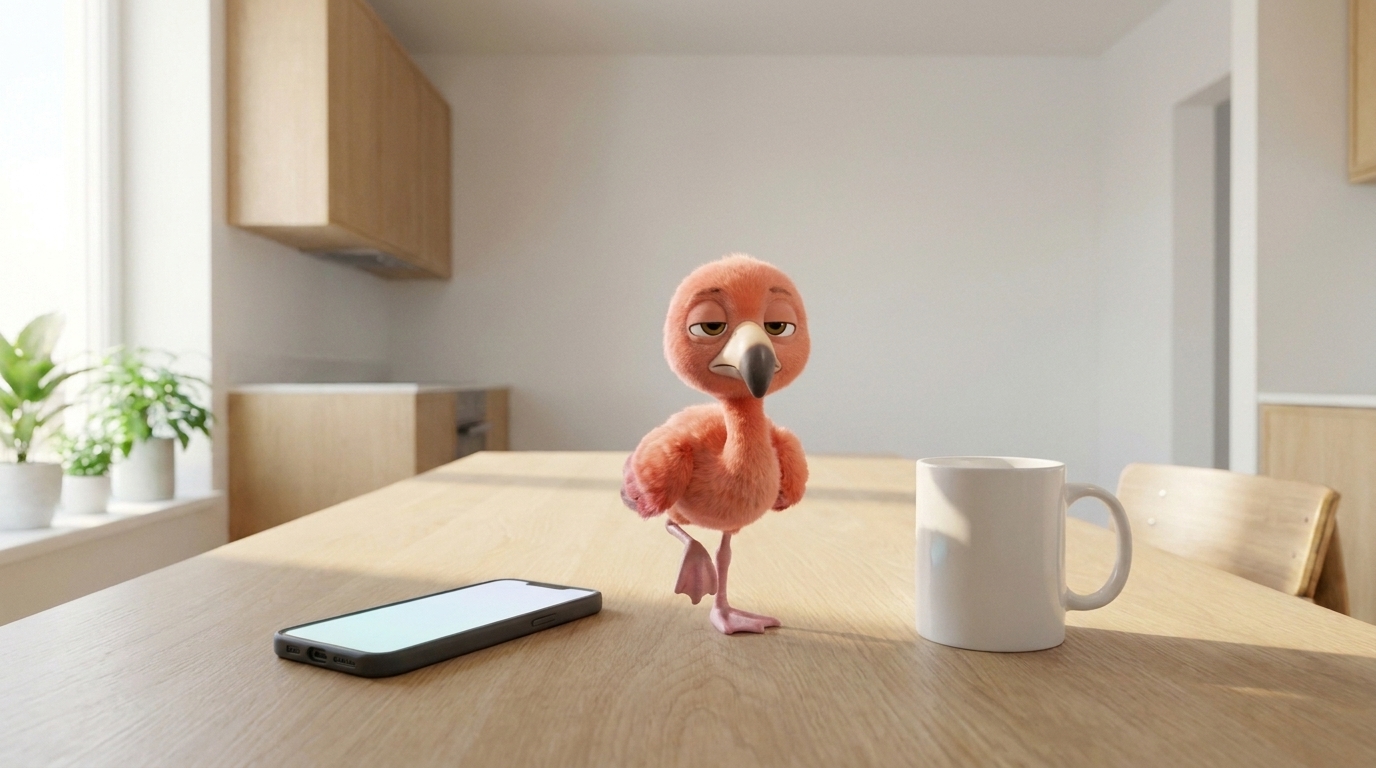
The frame every other Frankie frame was edited from. Phone on speaker, hold timer running at 47:12, and a stare that has been waiting a very long time.
Robot: “Your call is important to us.” Frankie: “Is it, though?”
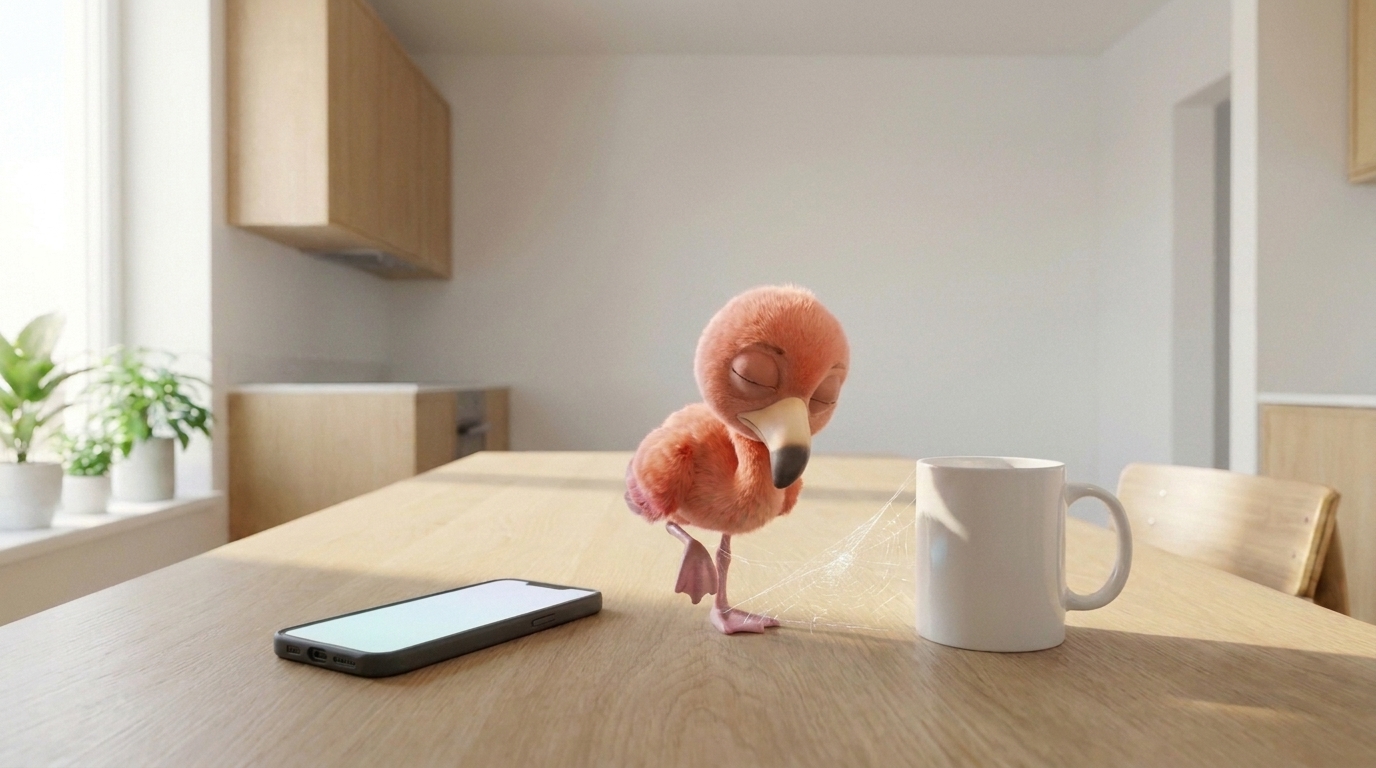
Same frame, one change: Frankie is asleep on one leg and the timer has jumped to 3:12:47. The cobweb from his foot to the mug does the rest of the joke.
Robot, again: “Your call is important to us.”
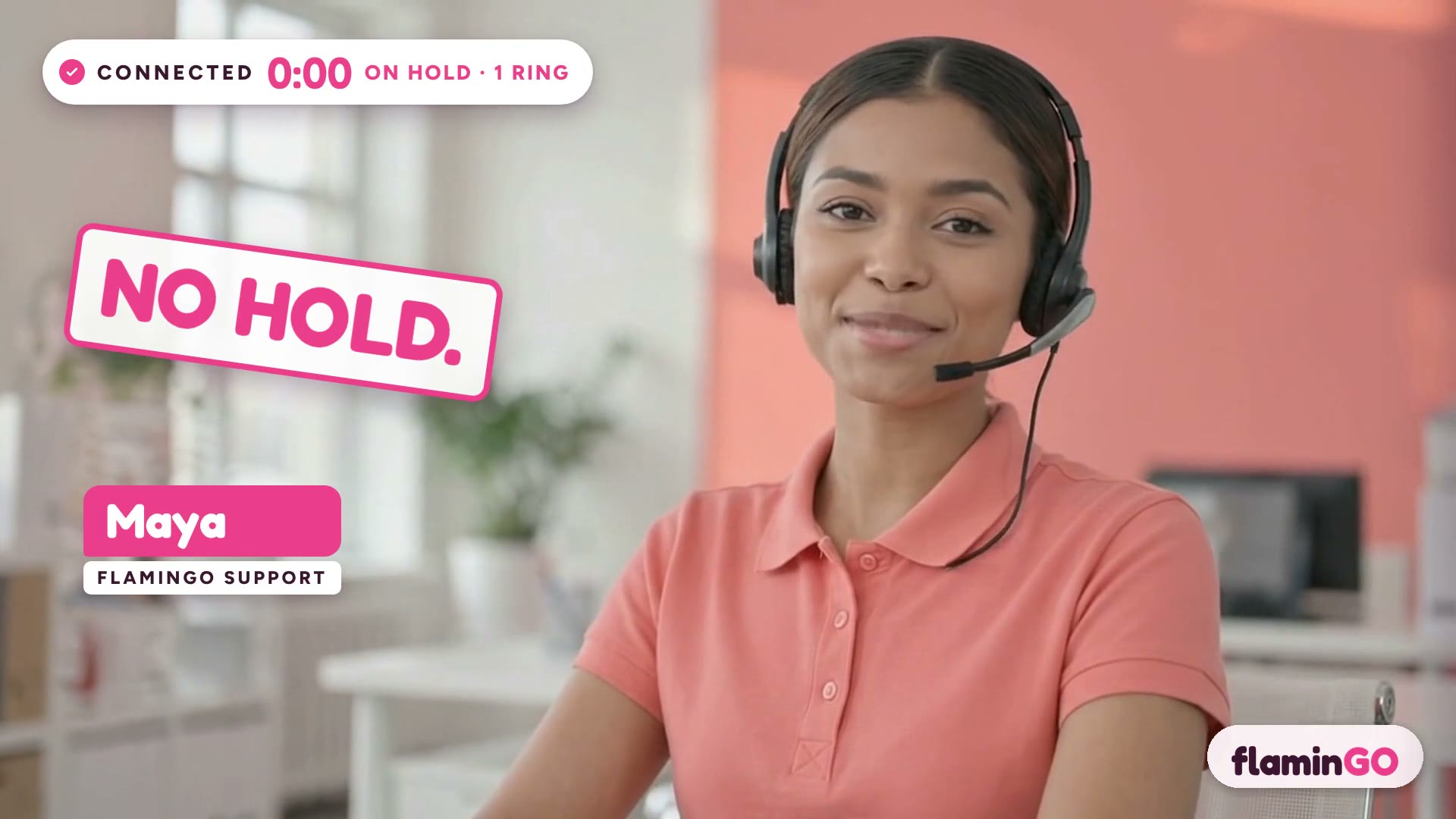
Frankie pecks the phone, hangs up, dials flaminGO, and Maya answers on the first ring. One ring, says the counter in the corner. No hold, says the stamp.
Maya: “flaminGO support, how can I help?”
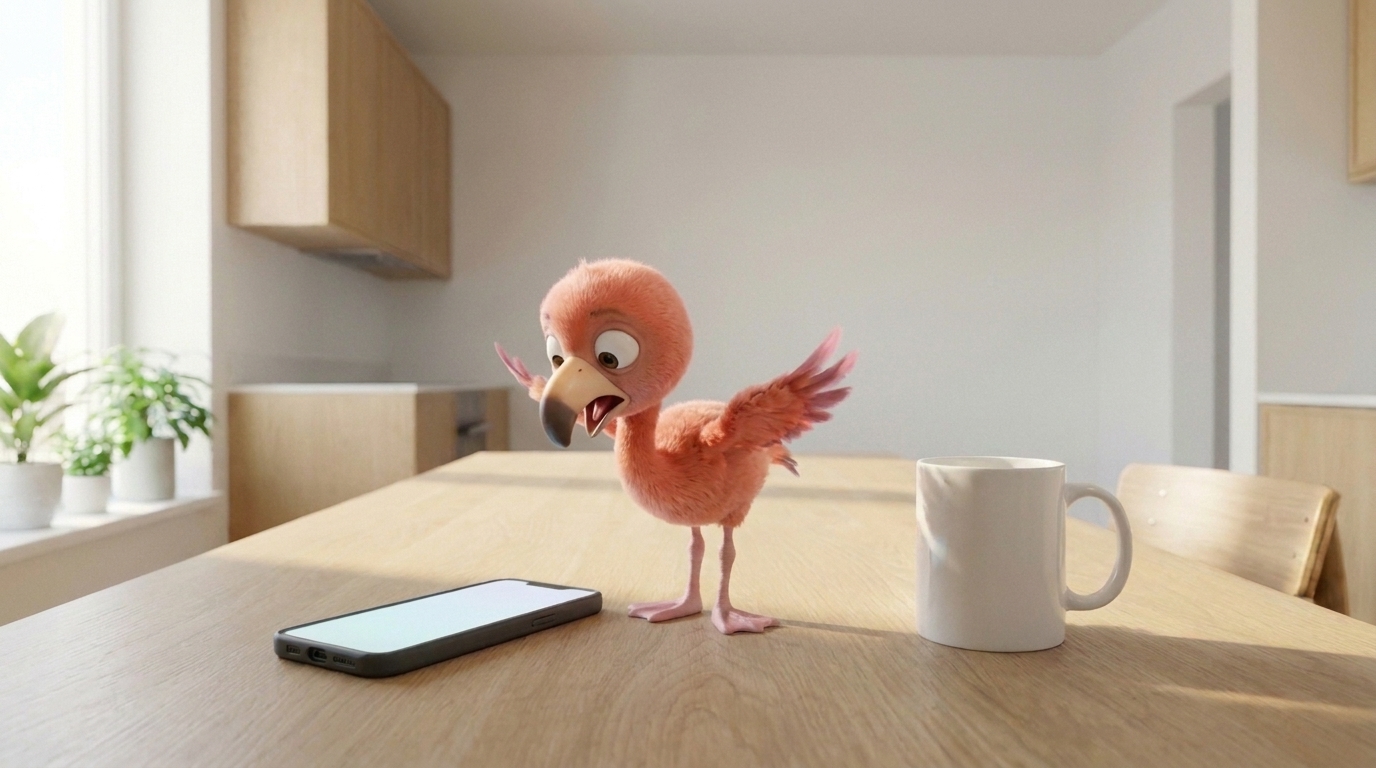
Three hours of robot will do this to a bird. The wobble, the flap for balance, and the double take are all in the frame the clip was animated from.
Maya: “One plan, one price, done.”
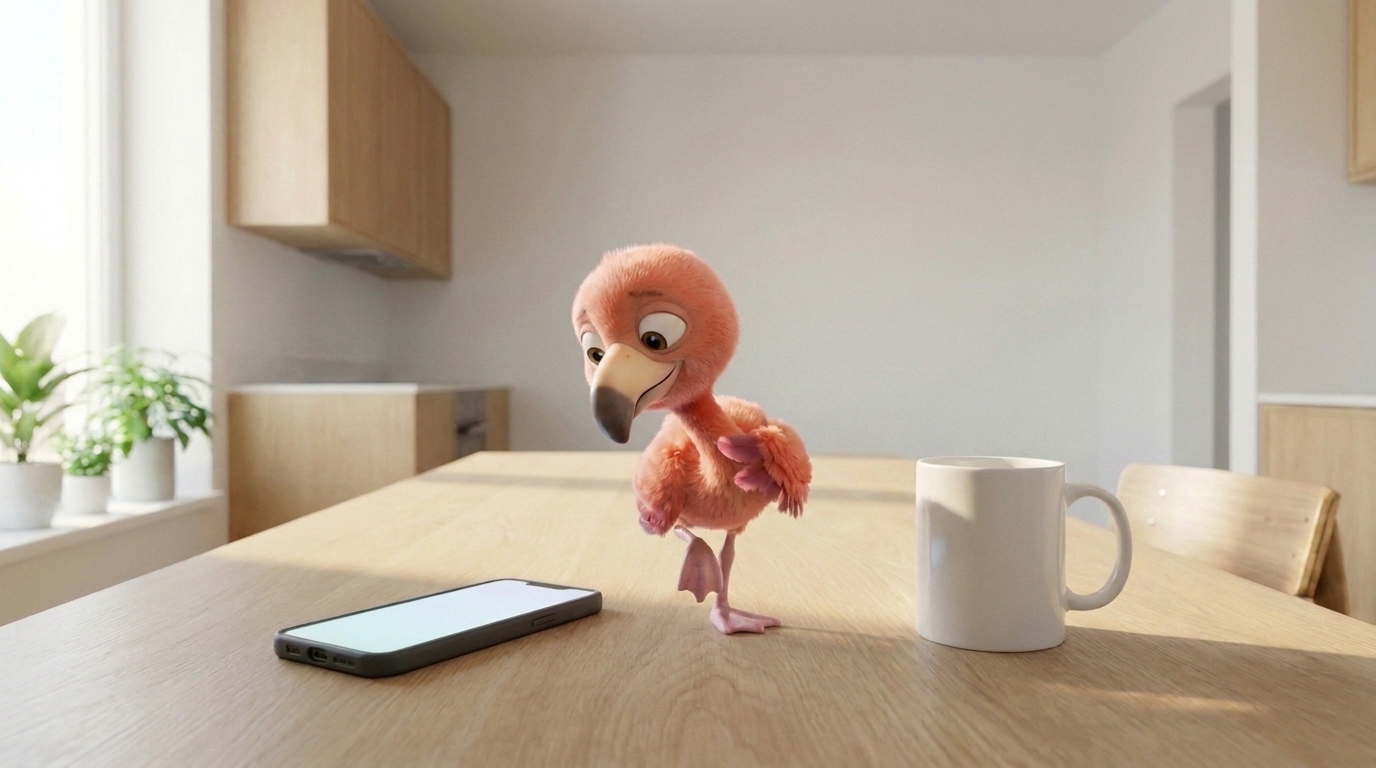
It is all sorted in one sentence, so Frankie leans in with the only request left. Wing to his chest, hopeful, slightly embarrassed.
Frankie: “Hey, Maya? Could you put me on hold anyway? I kind of miss the music.”
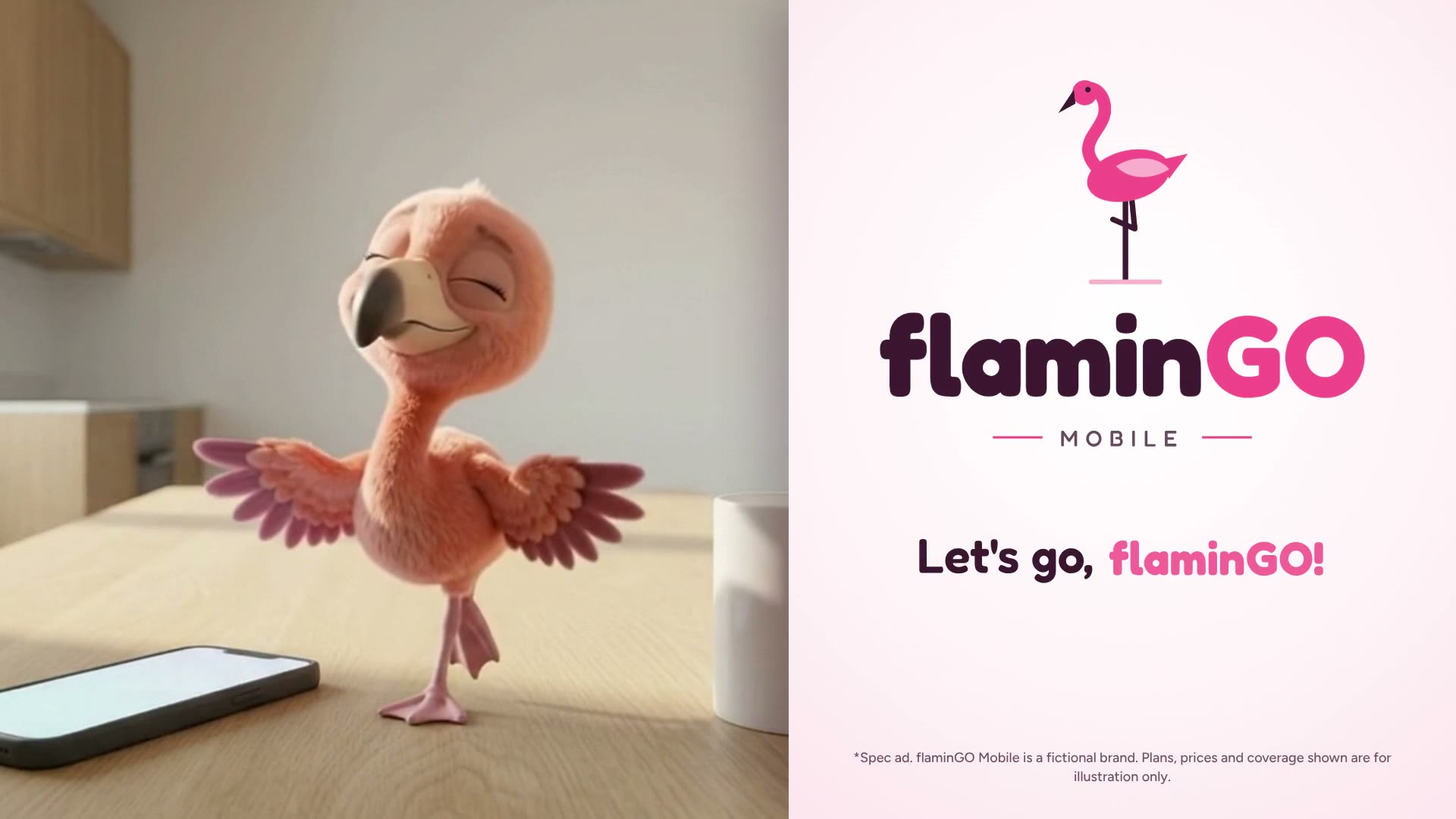
Frankie gets his music, the announcer gets one line, and the end card gets the whole campaign in three words before the jingle lands.
Announcer: “Flamingo Mobile.” Jingle: “Let’s go, flaminGO!”
Frankie did. This is the actual hold music from the film, all 108 seconds of it, the full track. Put yourself on hold. Your call is important to us.
A carrier page lives or dies on its plan cards, so here they are, exactly as pitched in the films. Every claim below is spoken by Frankie, shown as a caption, or both. In the second spot Maya sums the whole offer up in one sentence: one plan, one price, done. That was the production rule too: if it is claimed, it is on screen.
The price badge spins in at the balance act and again on the packshot. It is the only number in the spot, so it had to be the biggest thing on the page too.
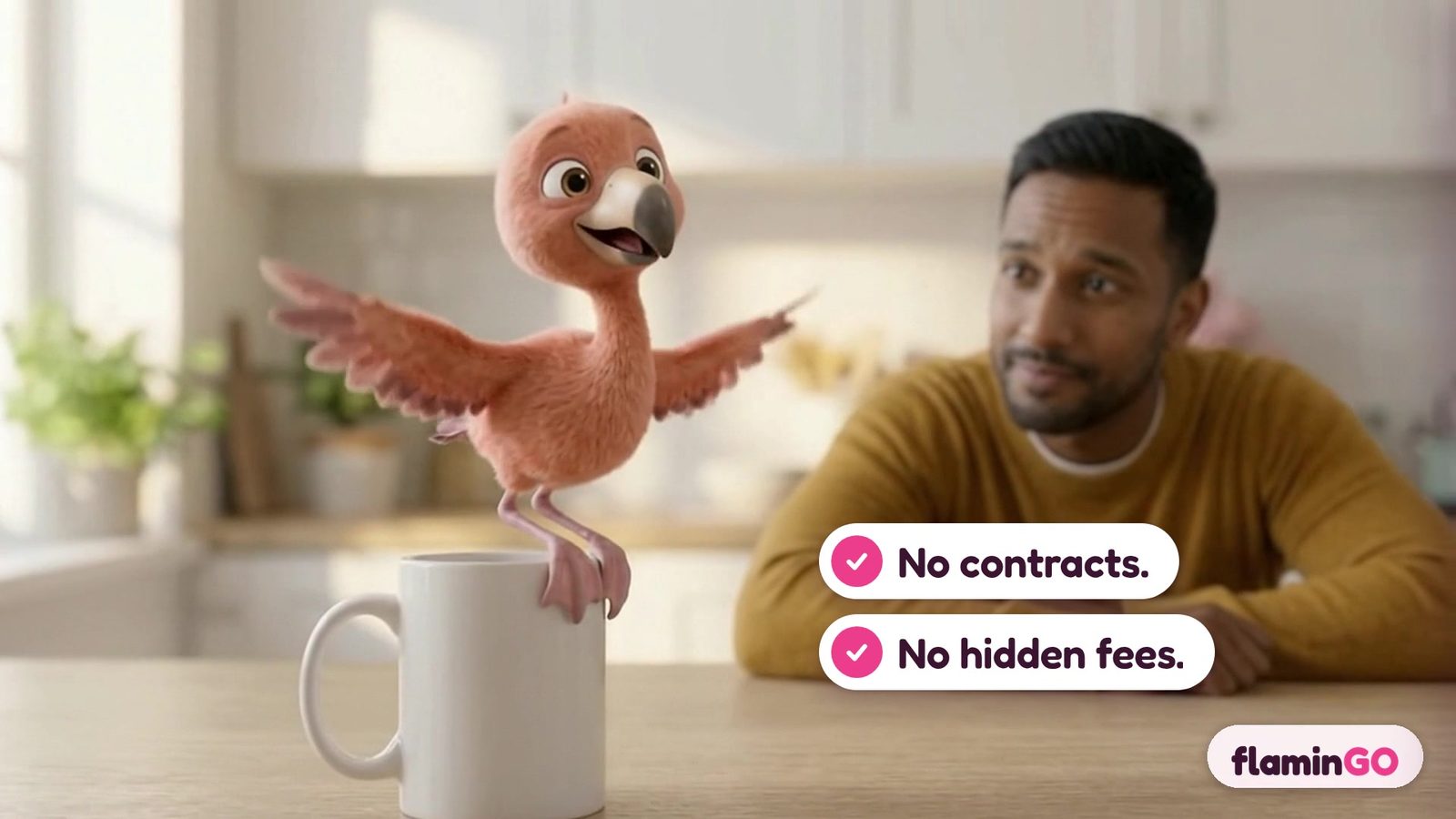
The first of two stacked captions, landing as Frankie balances on the rim of a coffee mug.
The second caption. The film’s joke is a bill long enough to build a nest from; the offer is the opposite of that bill.
Three signal bars pop onto the phone screen one by one as Frankie says it, with three soft pops in the mix.
“Same coast-to-coast coverage as the big guys,” delivered standing on top of the bill itself.
The switch pitch, delivered from Marcus’s shoulder, at his eye level, like a friend letting him in on something.
*Spec ad. flaminGO Mobile is a concept brand created for this production. Plans, prices and coverage shown are for illustration only.
34.7 seconds · 1920 × 1080 · 24 fps · Mix at -16 LUFS
Marcus winces at a phone bill so long it spills across the table: “Oof. That’s a big-carrier bill.” Standing on one leg beside his coffee mug is Frankie, a flamingo about the height of the mug, who has opinions about that bill.
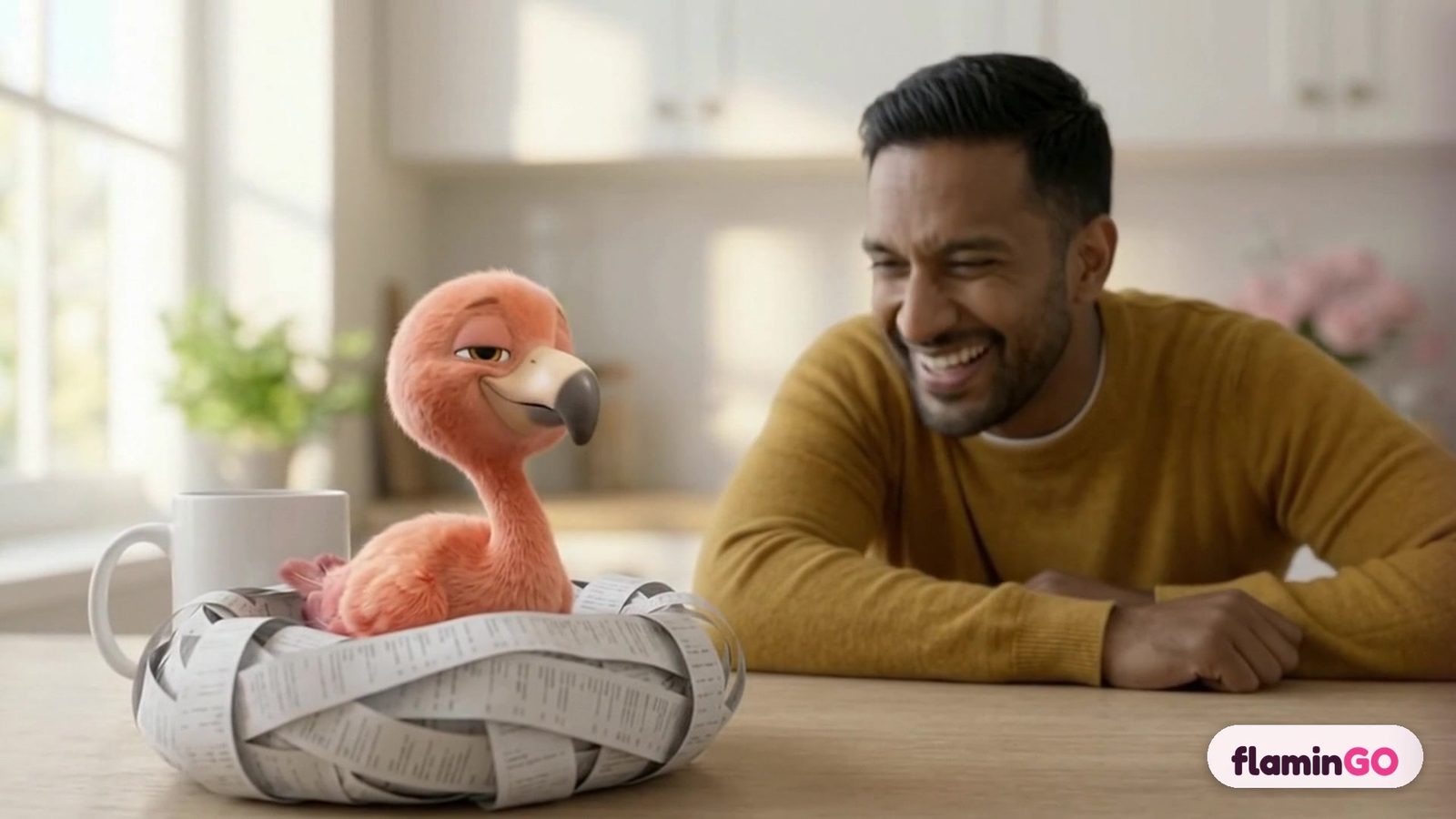
Frankie makes the whole pitch from the furniture: balancing on the bill, pointing at the phone, standing on the rim of the mug, riding on Marcus’s shoulder for the switch line. Then the button. Marcus finds Frankie settled into a nest woven from the old bill itself. “Is that… my old bill?” “Finally good for something.”
Packshot, an announcer, and Frankie’s closer: “Switch to pink.” End card, with the sung jingle: “Let’s go, flaminGO!”
Frankie had to be the same bird, at the same size, in a photoreal kitchen and a pink studio, standing next to a mug, a phone and a man, ten shots in a row. The system that held him together was built before a single shot: seven master references, approved in order, and a single rule that the references always win. Shot prompts name what each attached image is and describe only the shot; they never re-describe Frankie in words, because text competes with the picture.
R3The size lock: Frankie a little taller than the mug, a little shorter than the phone, attached to every Frankie shot 3 maxingredients per shot, never more EditSmall faults fixed with an edit prompt, never a regenerate
For “Hold, Please” the same rule got stricter. One master frame of Frankie on hold, approved first, and every other Frankie frame a single-change edit of it: asleep, startled, sheepish. The bird who falls asleep under a cobweb is the bird who wakes up, because both frames are the same frame.
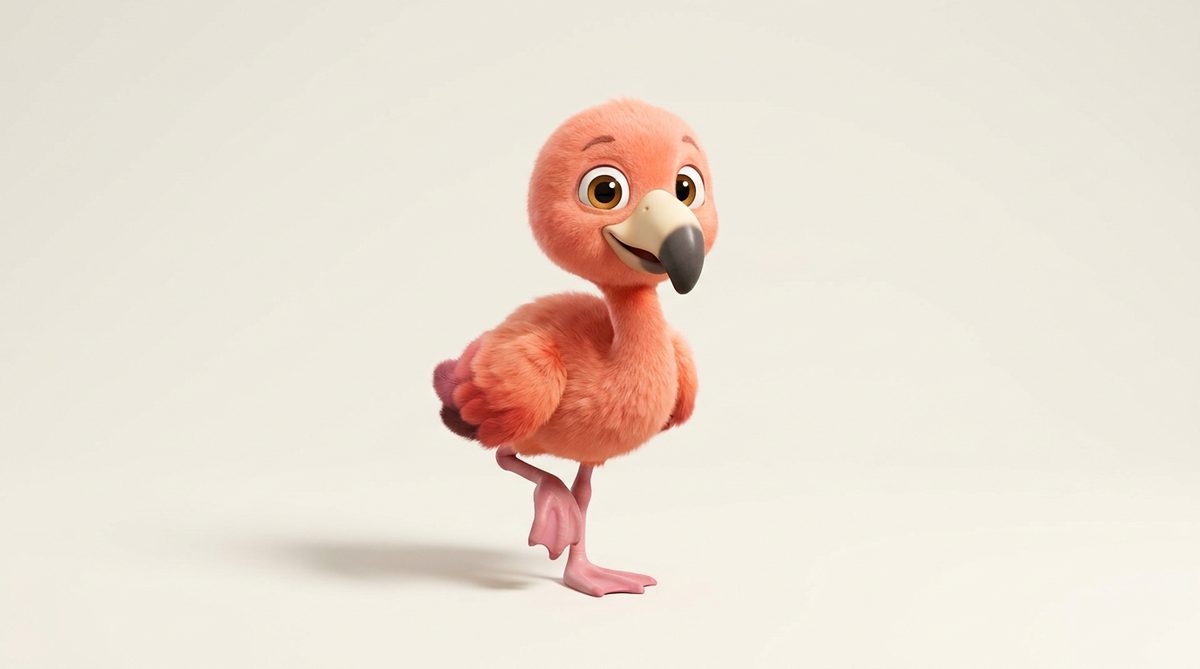
The character lock. Coral pink, not magenta, cream beak with a charcoal tip, one leg tucked.
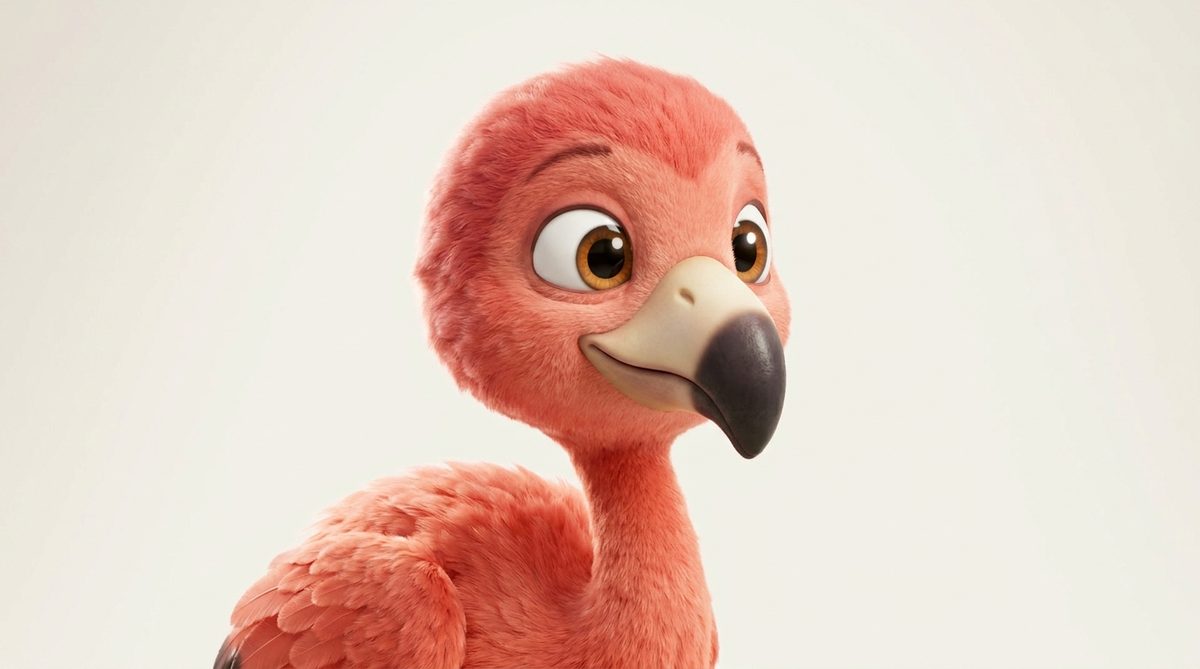
Same face, eye colour and beak as R1, close enough to check the expression work.
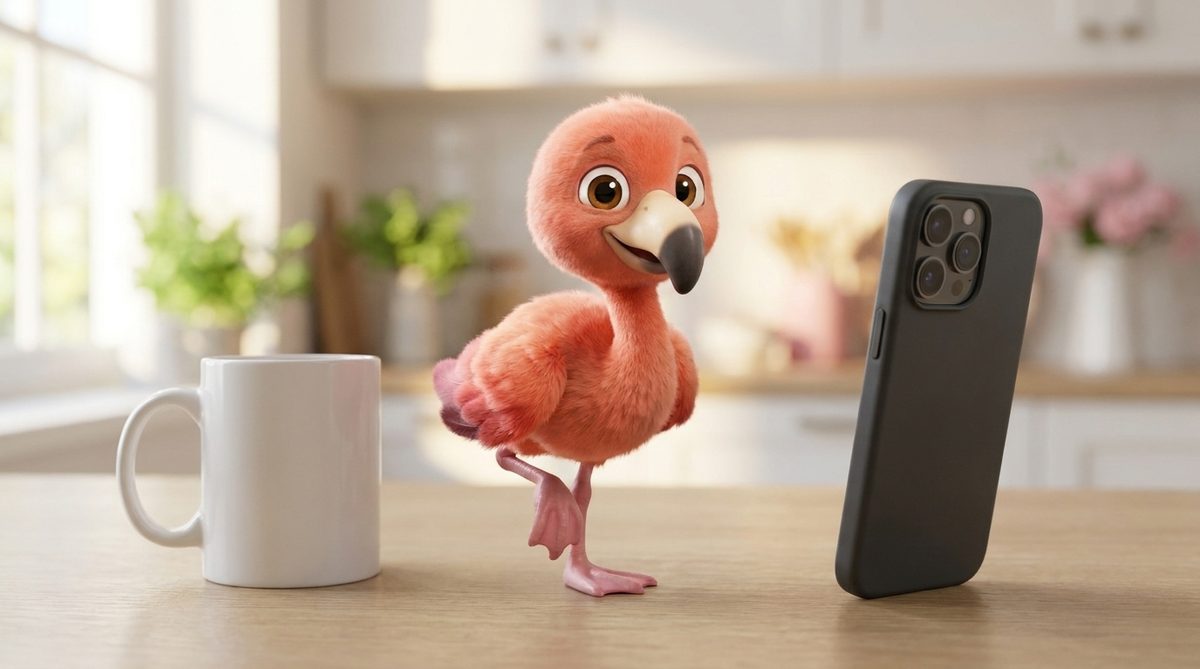
Frankie between the mug and the phone. Every shot’s scale comes from this one image.

Early thirties, mustard sweater over a white tee. Attached to every shot he is in.
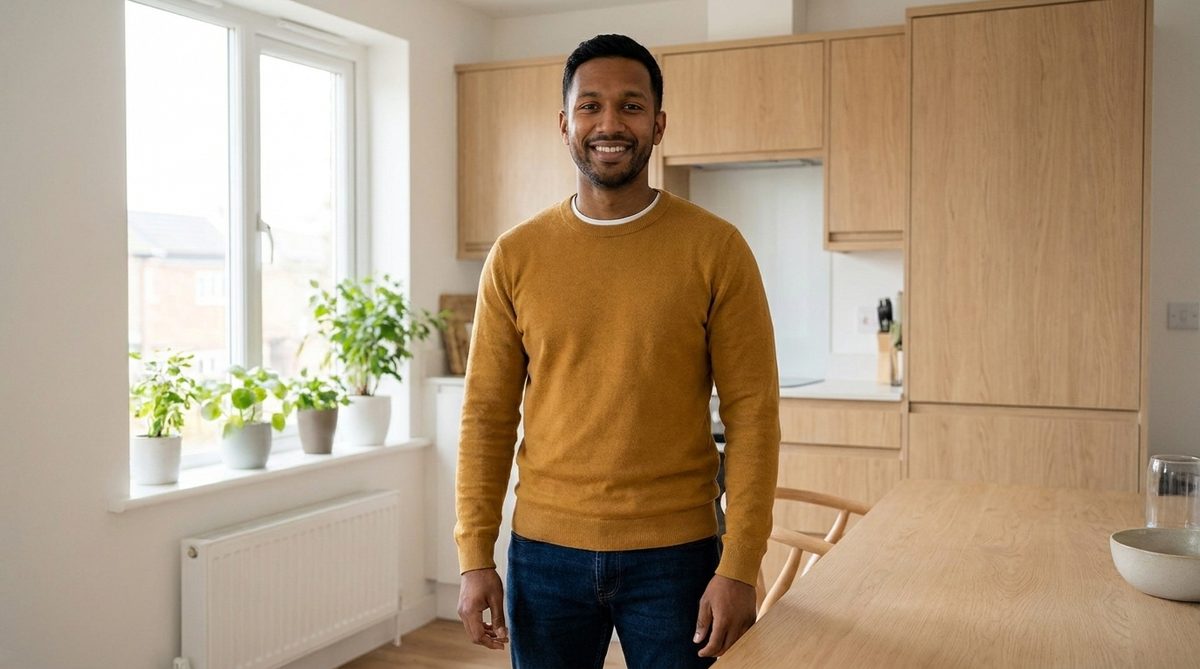
Same face as R4, for the wide shots.
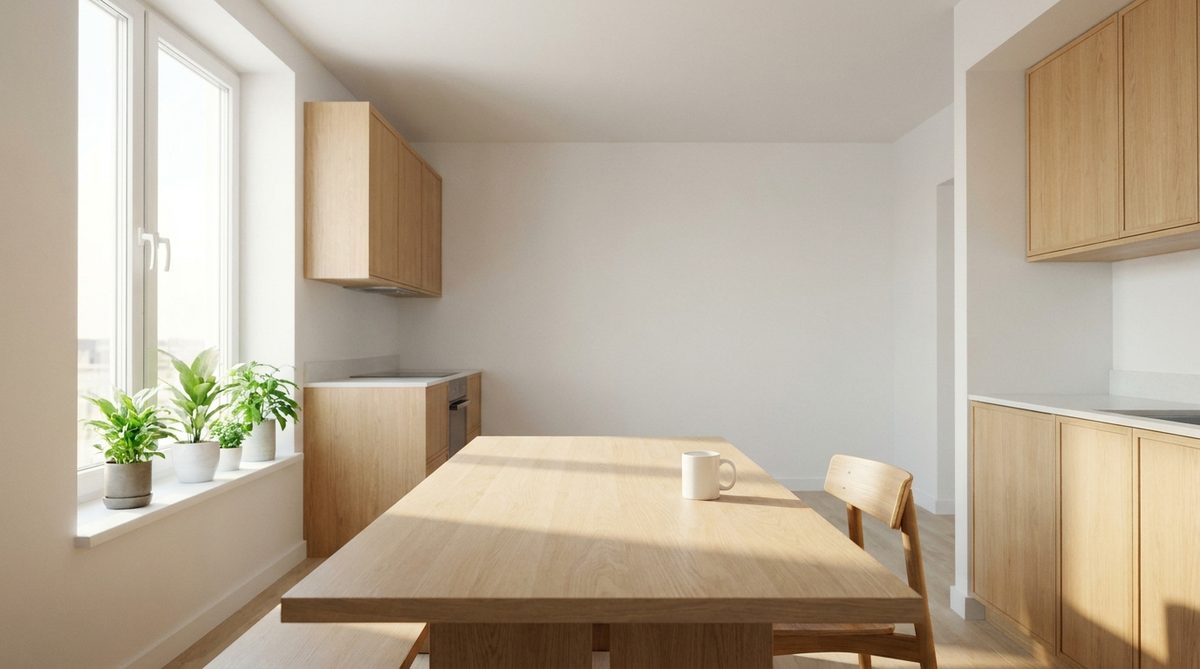
Window on the left in every kitchen shot. No pink in the room; pink arrives with Frankie.
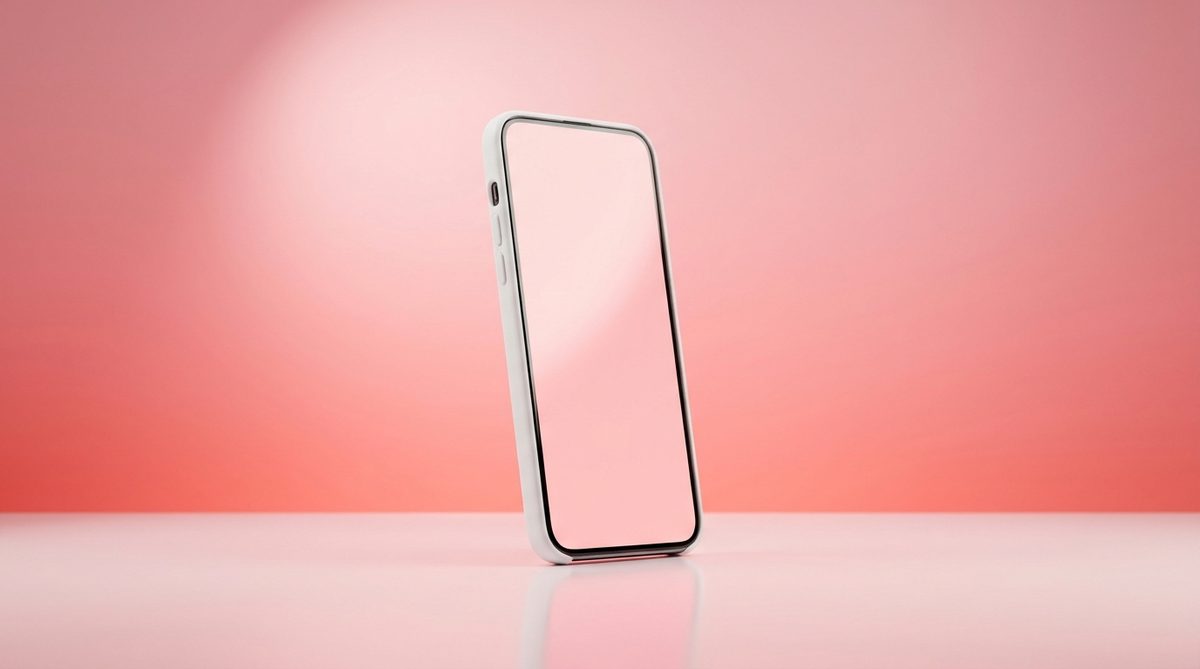
Warm coral backdrop and the white phone, screen a plain blush glow, ready for the logo to be placed in the edit.
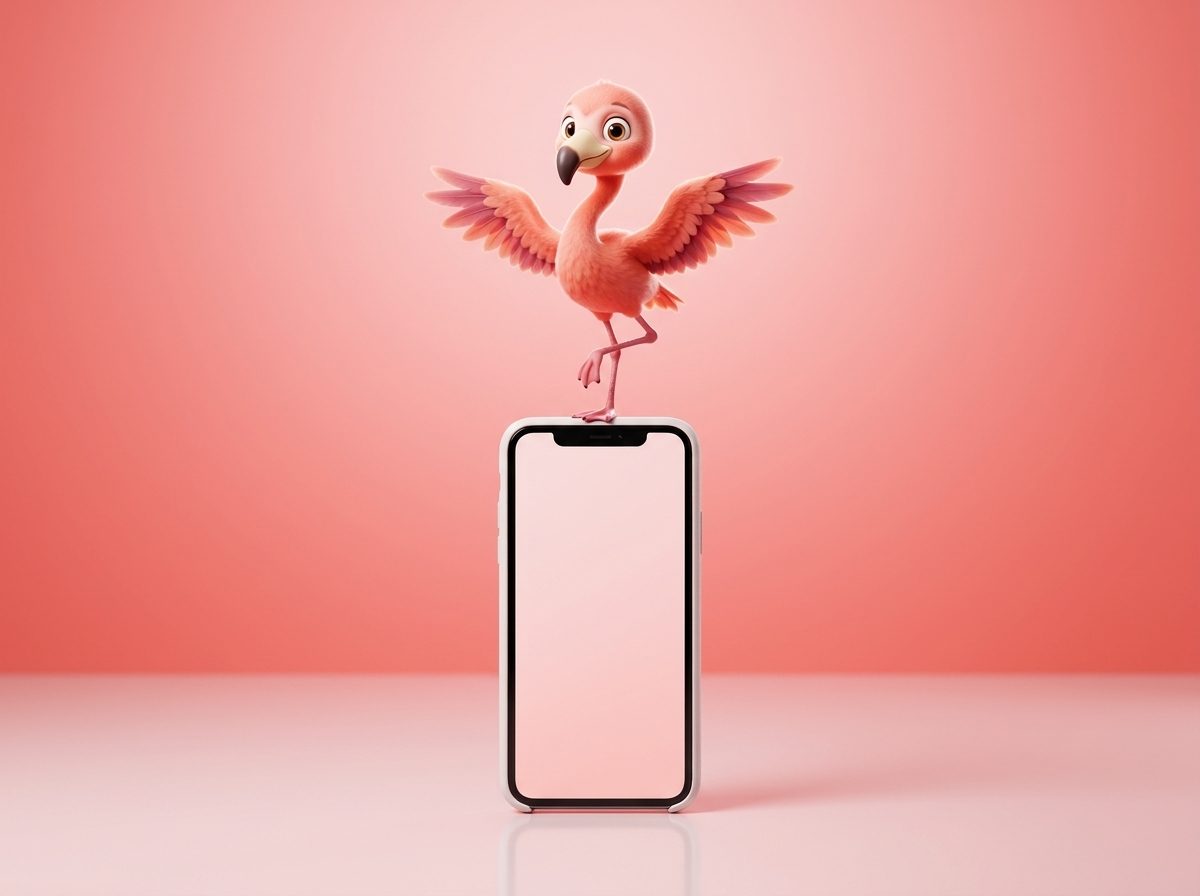
Frankie on the phone, built from R3 and R7. The campaign image, in 16:9 and 4:5.
These are the approved start frames each clip was animated from. Every motion prompt described movement only, followed by the same locks: Frankie keeps his size, shape and colours; Marcus keeps his face; one continuous shot, no cuts.
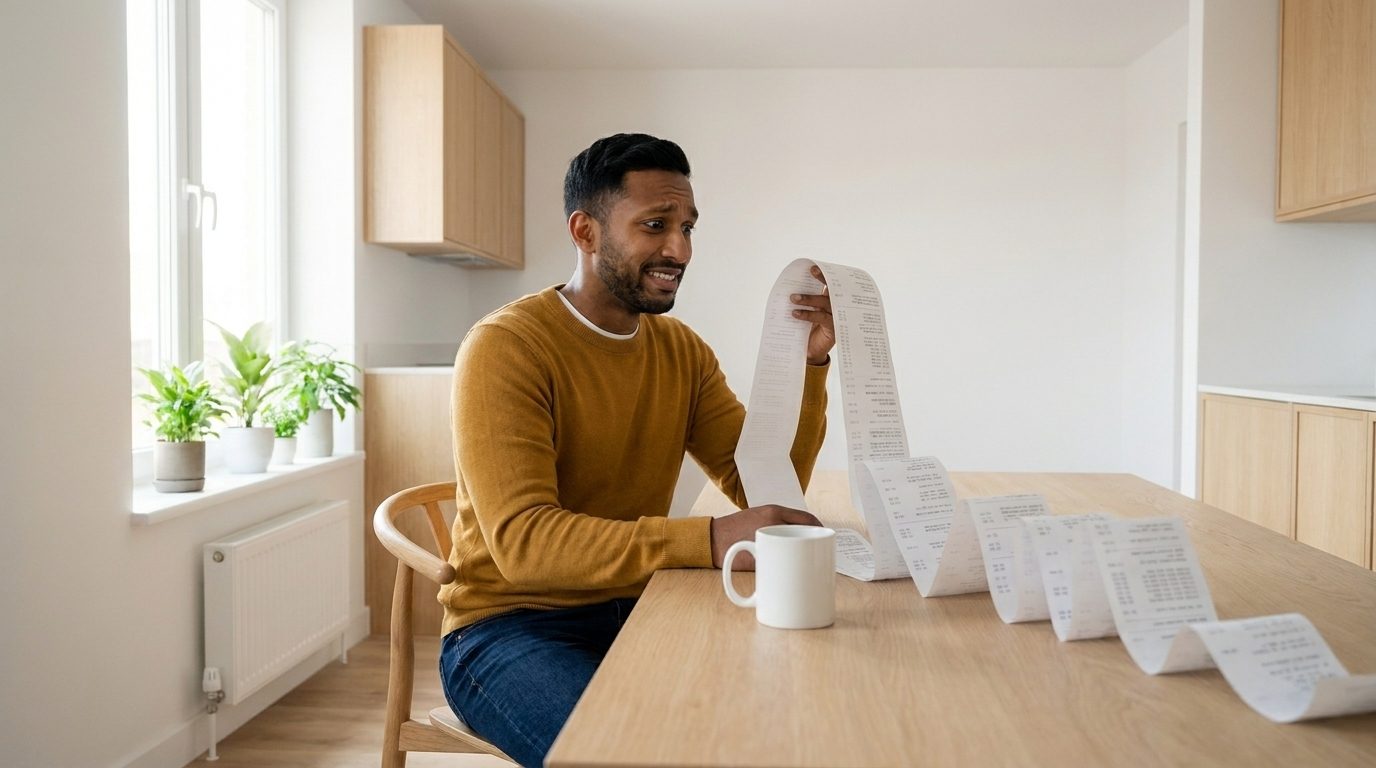
The bill unfolds into a concertina strip long enough to spill off the table. No Frankie yet; just the wince.
Marcus (voice): “Oof. That’s a big-carrier bill.”
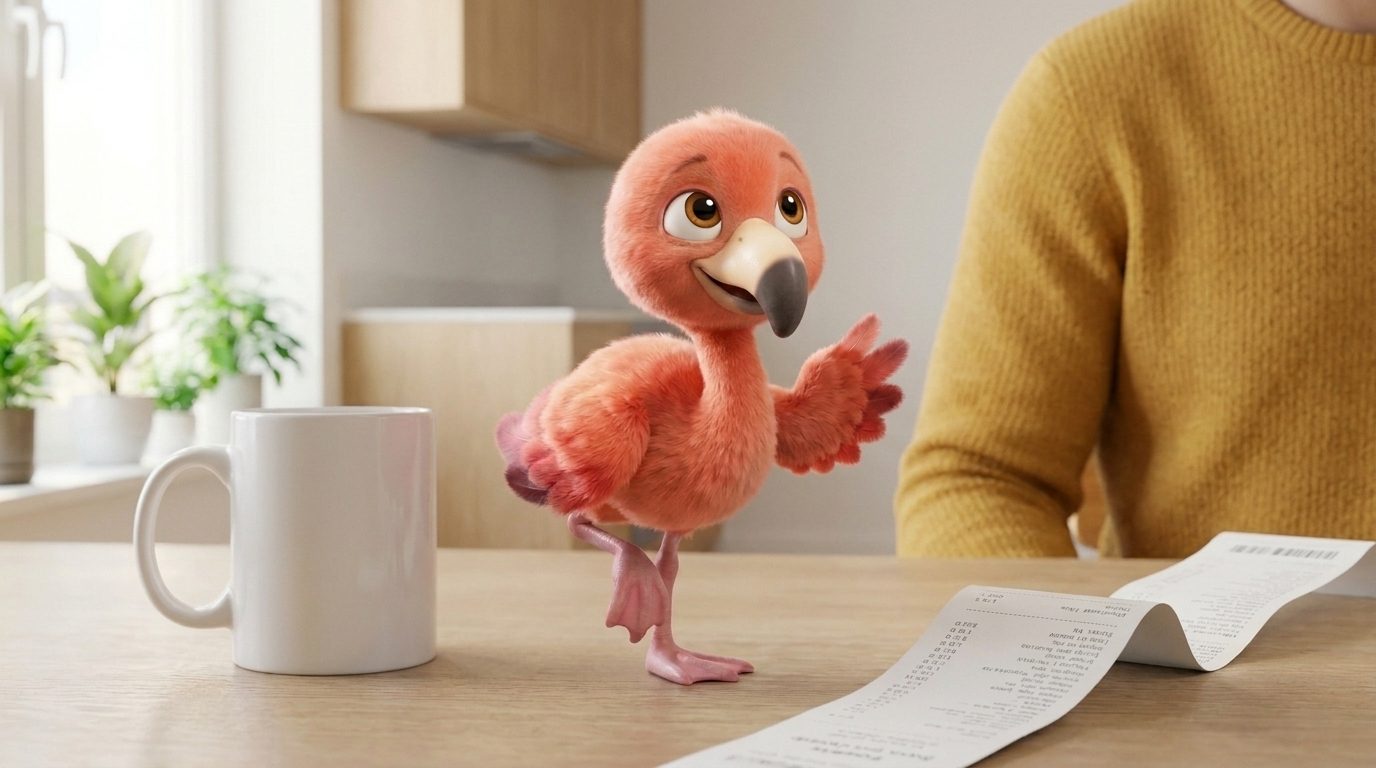
No graphics on this shot at all. A small wave, a tilt of the head, and the name tag arrives beside him.
Frankie: “Hi! Frankie. From Flamingo.”
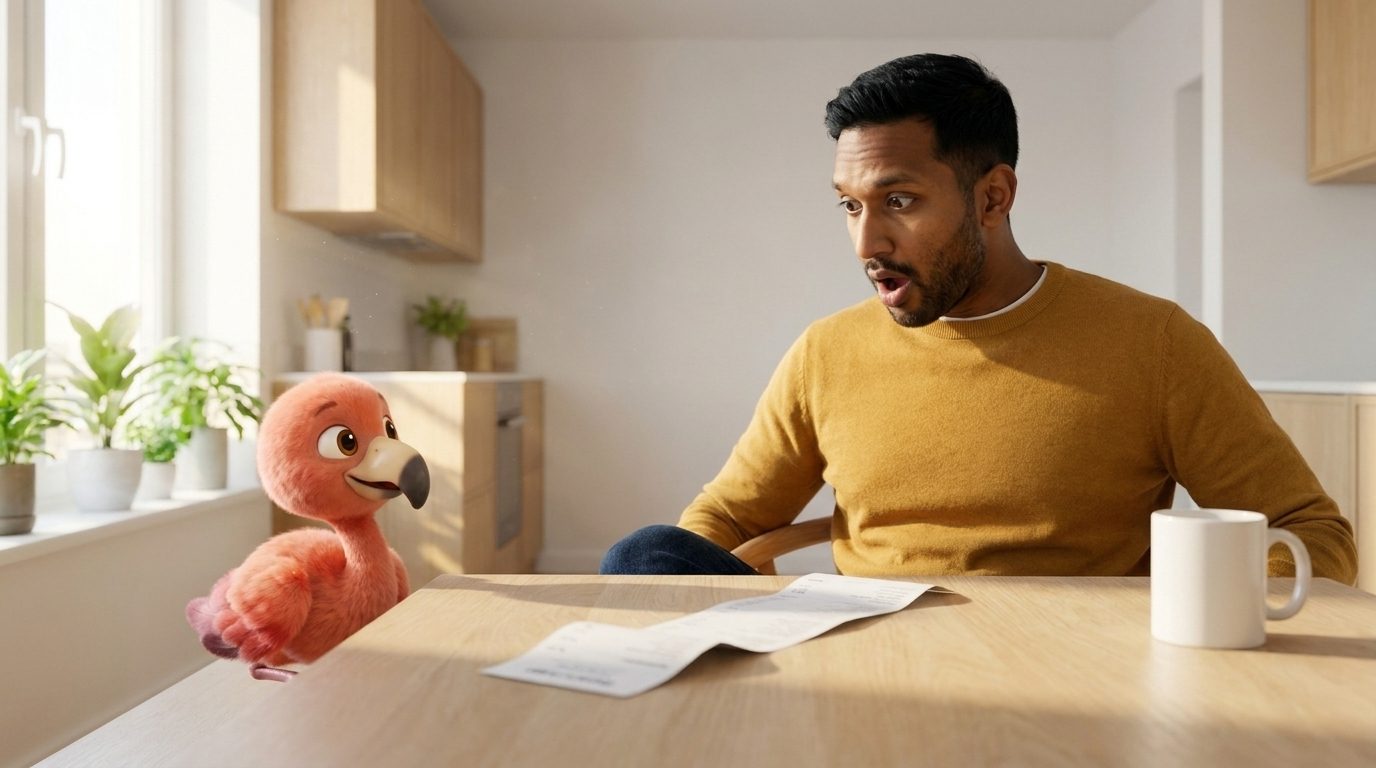
Shot past Frankie in soft focus, so the size joke reads in a single frame: tiny bird, full-size reaction.
Marcus: “You’re… a flamingo.”
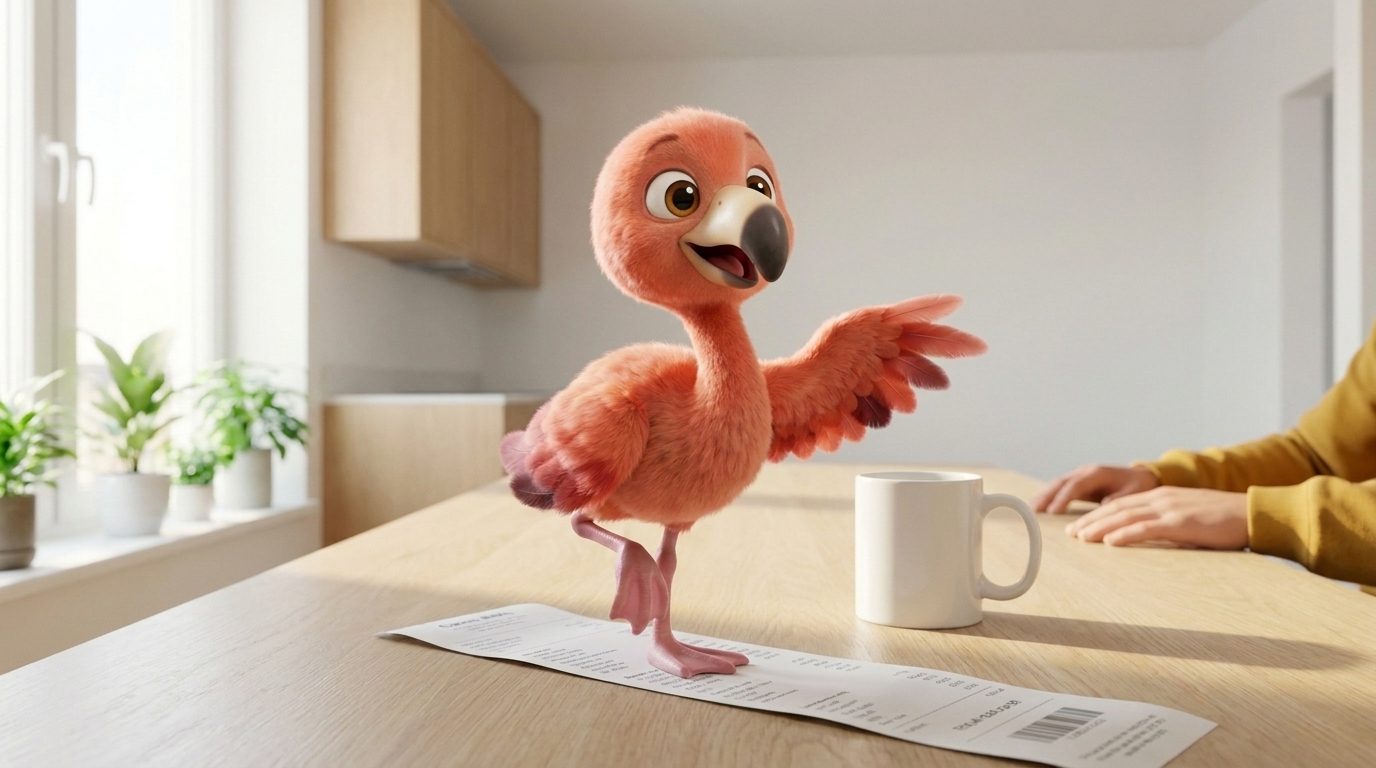
Frankie delivers the coverage line standing on top of the bill itself. The coast-to-coast caption sits lower left, clear of him.
Frankie: “A small one. Big savings, though. Same coast-to-coast coverage as the big guys.”
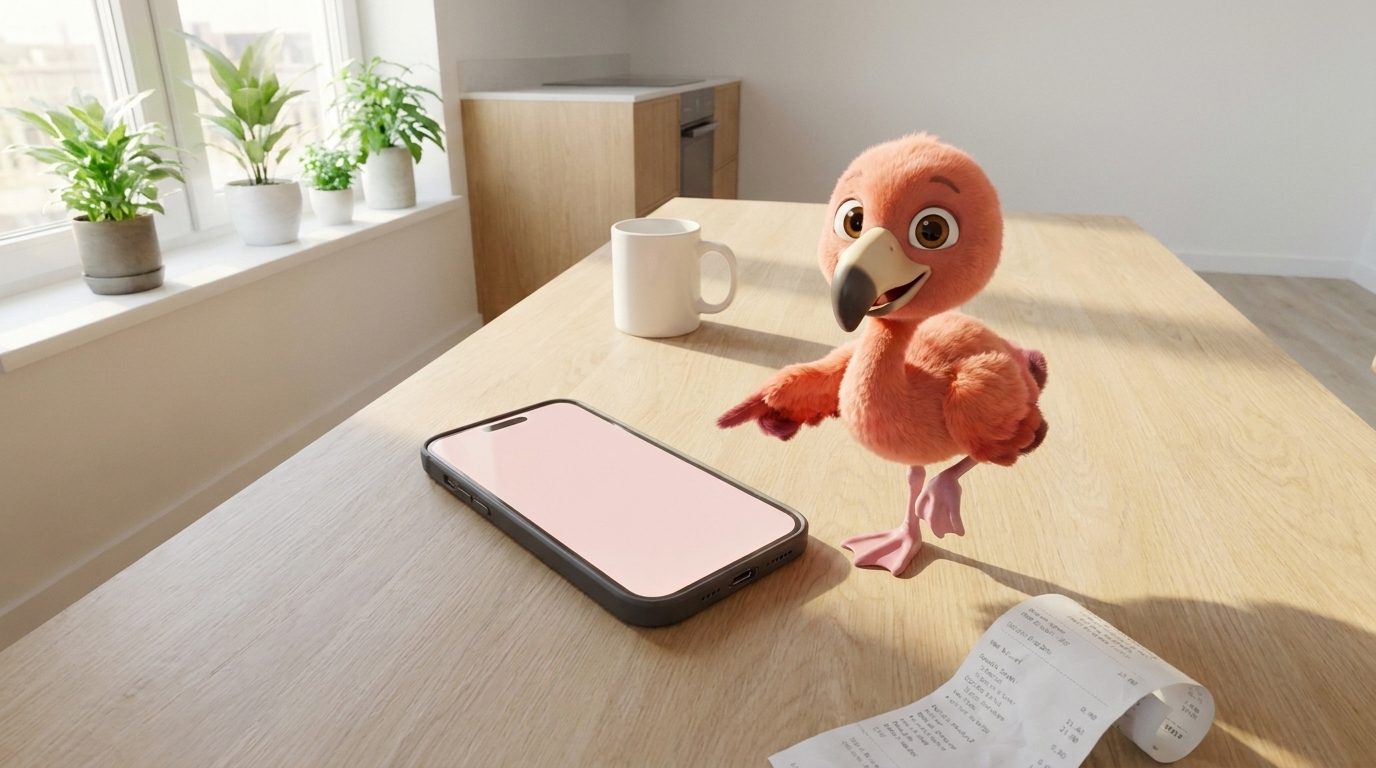
The camera does not move in this shot, so the three signal bars could be pinned to the phone screen in the edit, popping on one by one.
Frankie: “Unlimited talk, text and data.”
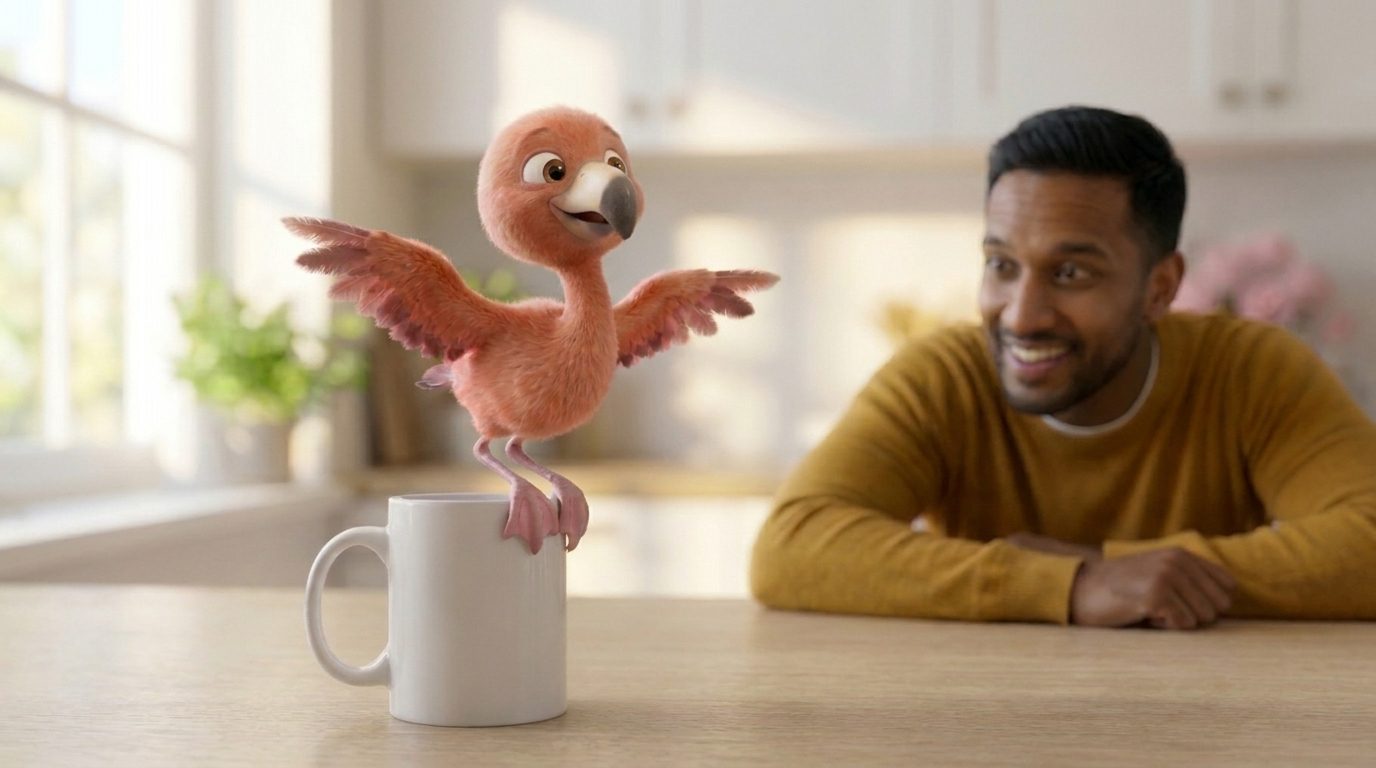
Built by editing the approved S02 frame rather than generating fresh, so Frankie stays identical. Foot on top of the rim, toes curled over it, wings level.
Frankie: “No contracts. No hidden fees. Plans from twenty-five bucks a month.”
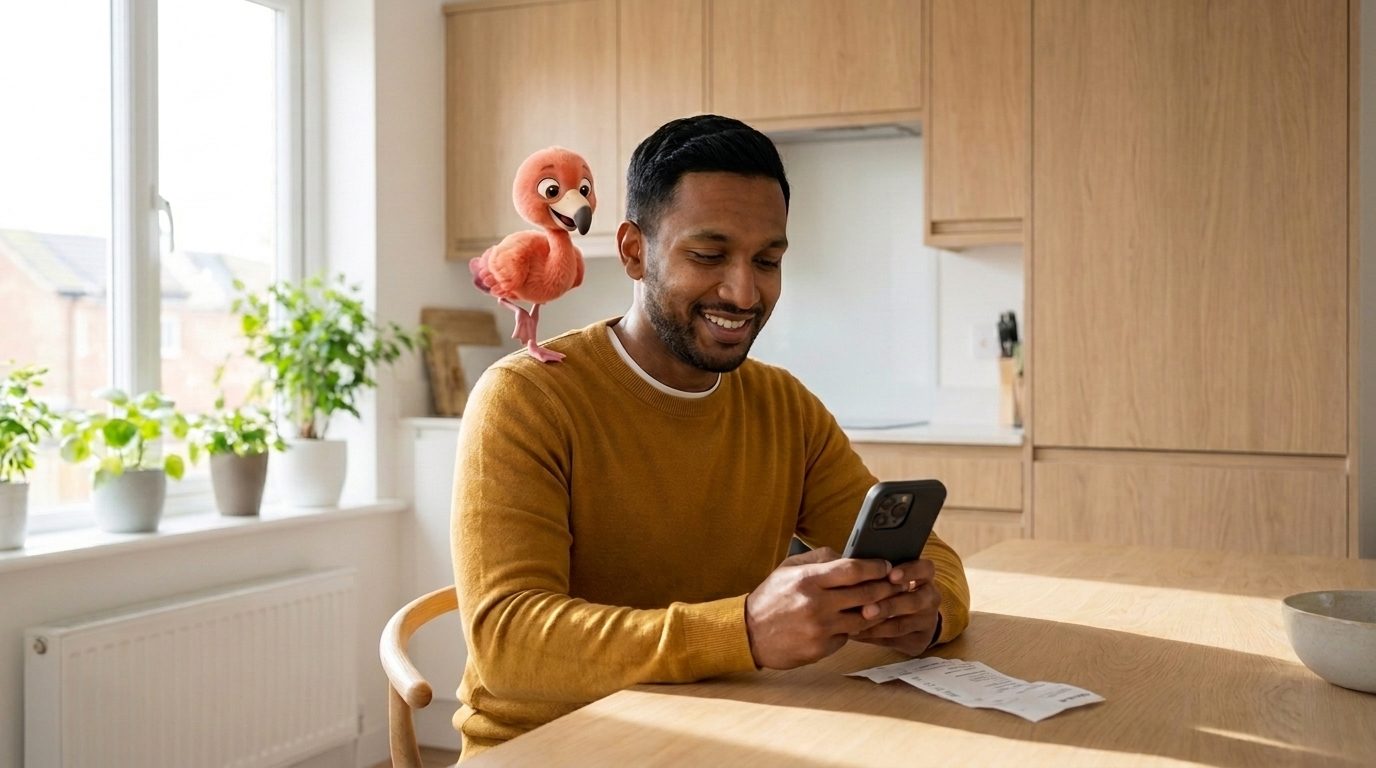
Frankie rides the shoulder and nods along with the phone. The phone screen stays turned away from camera.
Frankie: “Switching’s easy. Keep your number. Keep your phone.”
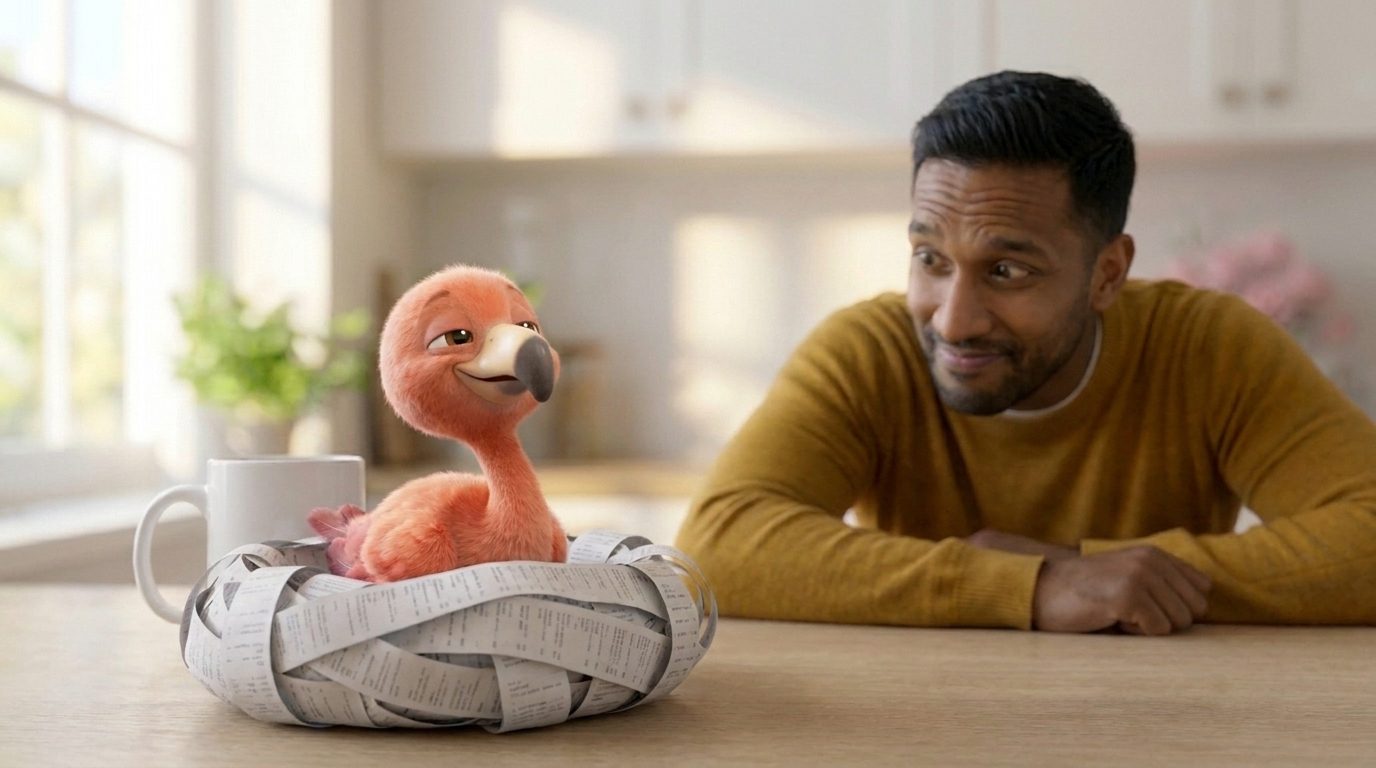
This ending was written after the third cut, when the original closer was not landing. The premise pays off: the bill becomes the nest. It replaced the earlier shot outright.
Marcus: “Is that… my old bill?” Frankie: “Finally good for something.”
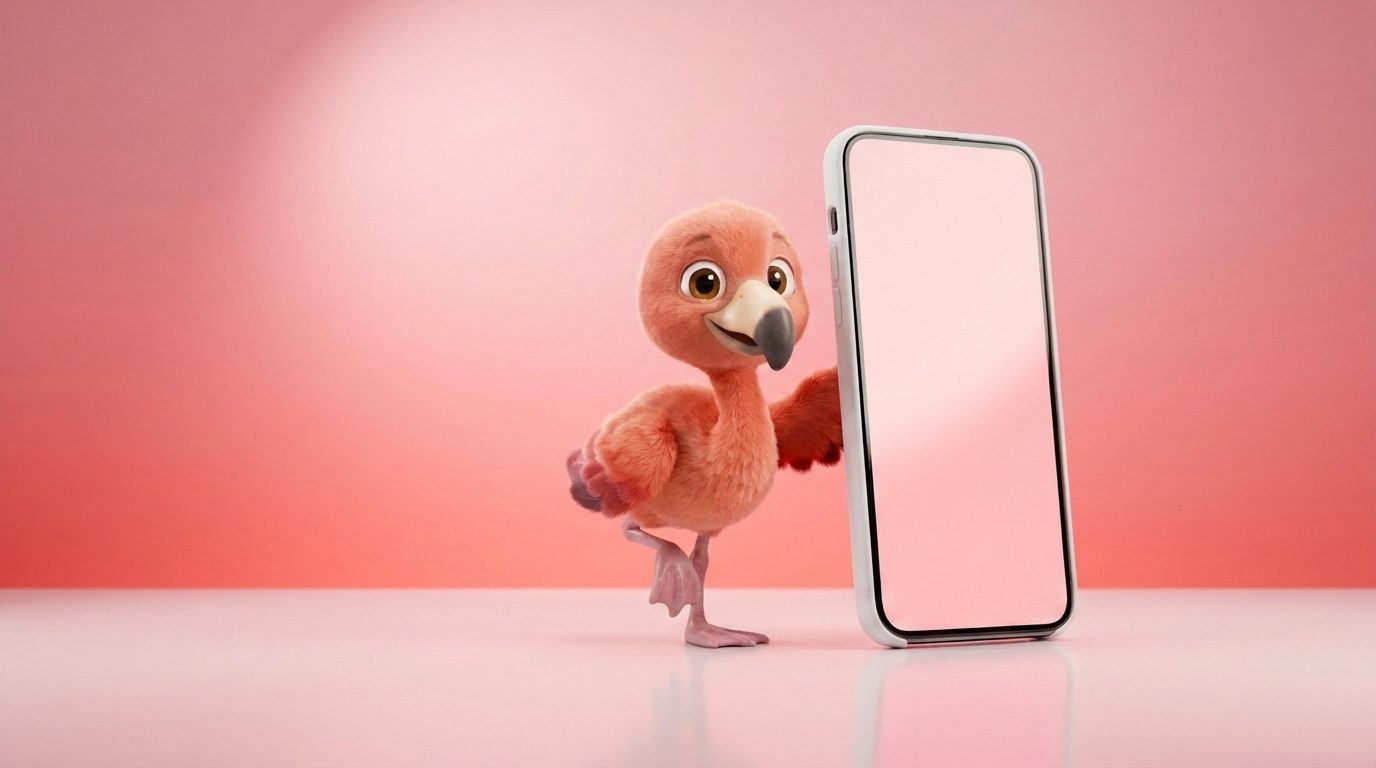
Into the pink studio. The stacked logo is tracked onto the phone screen through the push-in, and the price badge sits in the empty left third.
Announcer: “Flamingo Mobile.”
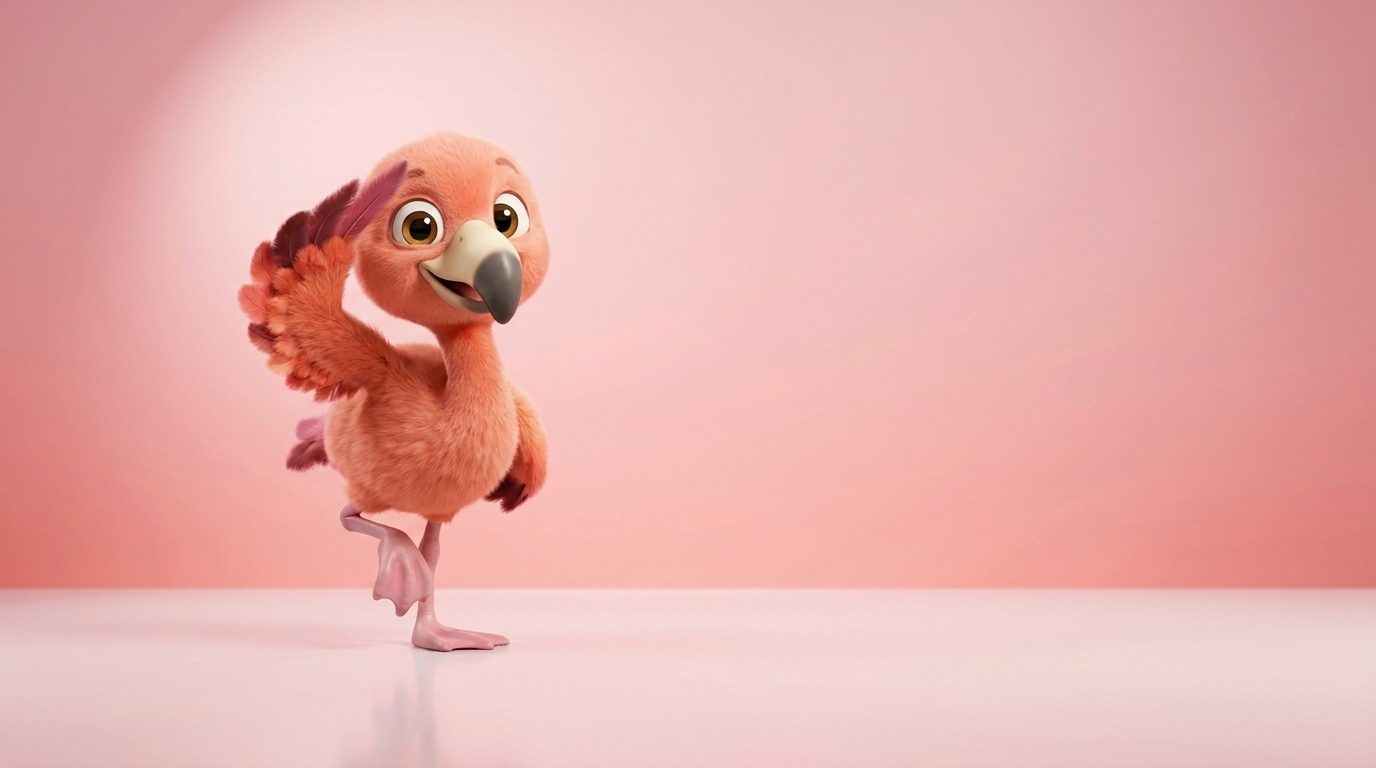
Frankie holds the left third and salutes; the right two-thirds were composed empty so the end card could build beside him.
Frankie: “Switch to pink.”
The first spot had to make a mascot stay on model for ten shots. The second had to make him funny in one room, at one table, mostly standing still, and it had to fix a first version, built in Runway, that had not worked for Frankie, while keeping the parts of it that had. The third took him out of the kitchen entirely and put him in a stadium, at half the length of a football, for twenty-three seconds. The system underneath barely changed; what changed is how hard it leans on one frame.
| Big-Carrier Bill | Hold, Please | Flag on the Play | |
|---|---|---|---|
| Premise | A phone bill so long it becomes a nest | A hold so long Frankie misses the music when it ends | A stadium of seventy thousand on hold, until Frankie throws the flag for holding |
| Frankie frames | Nano Banana Pro in Google Flow, from the seven locked references | Nano Banana Pro in Google Flow, from the same references; one master frame, every other frame a single-change edit of it | Nano Banana Pro in Google Flow; a referee-shirt reference plus a scale frame that keeps him half the length of the football |
| Motion | Omni Flash 1.1 in Google Flow | Omni Flash 1.1 in Google Flow for the new Frankie clips; Maya’s two shots produced in Runway and kept, picture and lip sync unchanged | Omni Flash 1.1 in Google Flow |
| Frankie’s voice | Flow performance converted in Speechify Voice Changer, Lindsey (F), accent on | Same method, same voice | Same method, same voice, with a little stadium air around it |
| Other voices | Marcus, and the announcer, Julien | Maya re-voiced in Speechify Voice Changer over her kept lip sync; the phone robot by Speechify text to speech; announcer Julien reused | The quarterback in the clips’ own voices, so the sync is theirs; a booing, then roaring crowd; announcer Julien |
| Music | Suno tropical-pop bed at 104 BPM, plus the sung jingle | The same bed and jingle, plus the hold music as a story element, heard through a phone, then in full when Frankie asks for it back | A new Suno epic sports score at 104 BPM: orchestra, marching drums and choir chants, ending on the same sung jingle |
| Graphics | Pill captions, price badge, corner bug, end card | The same system, plus the hold timer pill, the ring counter and the NO HOLD stamp | A full broadcast package in Barlow Condensed: PLEASE HOLD jumbotron, the FLAG ON THE PLAY / HOLDING penalty card, the FIRST RING support card, kinetic supers, corner bug, end card |
| Finish | 34.7 seconds, five cuts, -16 LUFS | 45.7 seconds, -16 LUFS | 23.5 seconds, -16 LUFS |
The animation performances already had the right timing, with beaks and mouths moving on the right syllables. So the dialogue was extracted shot by shot, run through Speechify Studio Voice Changer into one consistent voice per character, and put back at its original timestamps. Timing never changed, so the sync held, measured at 0 ms offset on every line.
Frankie is voiced with Speechify’s Lindsey, accent on; the announcer is Julien. Late in the edit, two of Frankie’s lines were re-recorded as text to speech and fitted word by word to the existing beak movement, landing within 40 ms of the originals. The score is a Suno tropical-pop bed at 104 BPM, cut on bar lines and ducked under every line, with a sung Suno jingle on the end card. Sound design is deliberately small: paper rustles, three soft pops for the signal bars, a ceramic tink as Frankie settles on the mug rim, and a twinkle on the closer. Final mix at -16 LUFS.
“Hold, Please” adds two voices and one instrument. Maya’s performance in the Runway version was already right on camera, so her picture and lip sync were kept and only her voice was replaced, the same extraction and replacement at the original timestamps; the phone robot is flat text to speech, because a robot should sound like one. And the hold music, a full track of cheerful nothing, plays through a phone speaker for the first half of the film and in full for the button, when Frankie sways to it with his eyes closed. You can put yourself on hold with it, further up this page.
“Flag on the Play” scales the same mix up to a stadium: hold music echoing around the stands, cut dead by Frankie’s whistle, a crowd that boos the flag and then roars, and a new epic Suno sports score that lands its final hit on the jingle. The quarterback’s two lines are the clips’ own voices, kept for their sync.
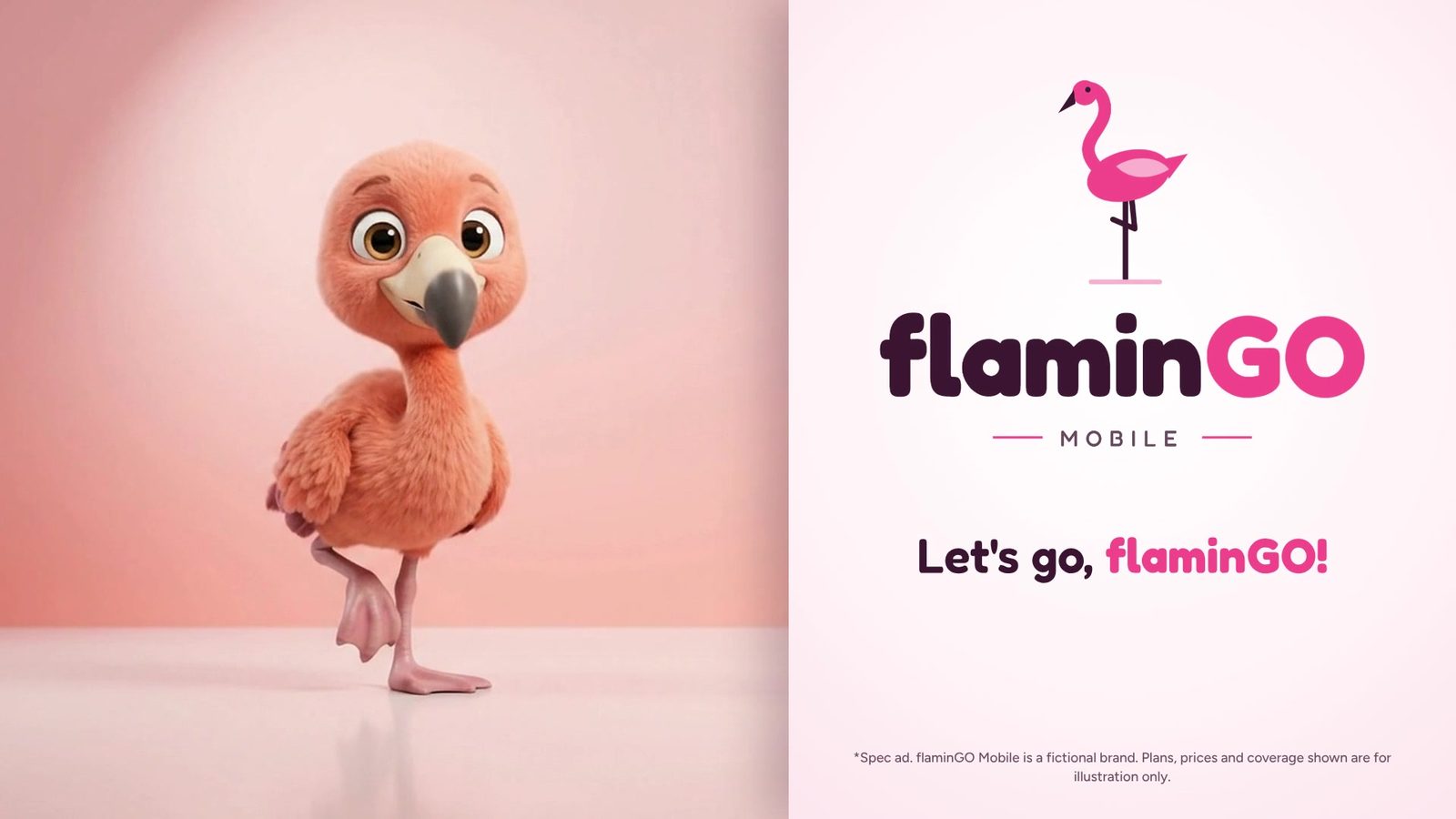
The logo is my artwork: the bird on one leg, “flamin” in plum, “GO” in pink, MOBILE in spaced capitals between two pink rules. Captions are white pills with a pink icon disc and plum text, set in Fredoka, with Figtree for labels and fine print. A wordmark bug sits in the bottom right corner through the film and leaves as the end card arrives. Supers never cover Frankie, a face, or the phone screen.
| Stills | Nano Banana Pro in Google Flow, 2K, 16:9. References approved first; small faults fixed with single-change edit prompts. |
|---|---|
| Motion | Omni Flash 1.1 in Google Flow, frames to video, 6 to 8 second clips, one continuous shot per take. |
| Voices | Flow’s own dialogue performances, converted in Speechify Studio Voice Changer and replaced at their original timestamps; new lines by Speechify text to speech, fitted to the mouths. |
| Music | Suno: tropical-pop bed, C major, 104 BPM, plus the sung “Let’s go, flaminGO!” jingle on the end card. |
| Graphics | Name tag, pill captions, signal bars pinned to the screen, price badge, corner bug, tracked screen logo, end card. Built as overlays in the edit. |
| Edit | Five cuts. v5 runs 34.7 seconds: a re-voiced opening line, the nest ending in place of the original closer, and the price badge timed to clear before the final cut. |
| Direction | Concept, direction and production by me, made with AI. Logo supplied by me. |
The Production Guide
Concept and brand, the seven locked references, all ten shots and their dialogue, the voice pipeline, music, graphics, all five cuts and the deliverables. Opens in a new tab.
A spec spot shows the film. This page shows the system around it: a brand, a mascot that stays on model across three films, a graphics package, a voice pipeline and a storefront that could go live tomorrow. That is the full scope of a creative director’s job on a launch like this, delivered end to end.
Spec ad. flaminGO Mobile is a concept brand created for this production. Plans, prices and coverage shown are for illustration only.